
Over the past few weeks, I’ve been sitting with one deceptively simple question:
Who are we as the Church?
Not: How many people are sitting in our pews?
Not: How many programs are we running?
Not even: How well are we maintaining our buildings and traditions?
But who are we becoming as followers of Christ?
Four words have emerged as I’ve wrestled with that question:
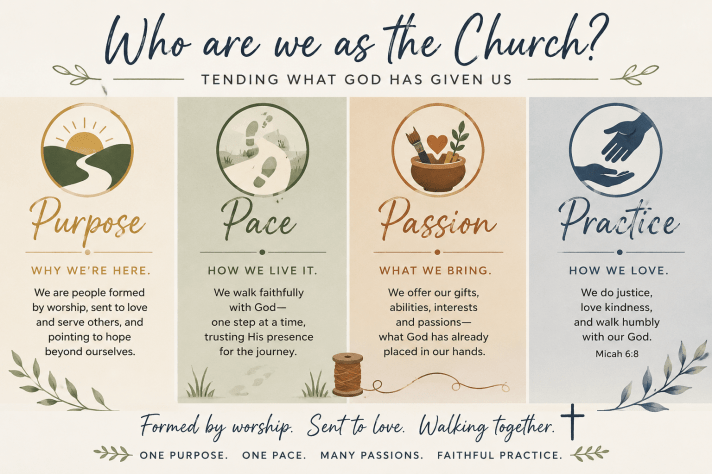
Purpose. Pace. Passion. Practice.
And together, I think they offer us a way of thinking about what it means to live faithfully—not only on Sunday morning, but throughout the week.
Purpose: Why Are We Here?
We began with purpose.
What is the Church actually here to do?
I keep coming back to three things:
Worship that forms us.
Love that serves others.
Hope that points beyond ourselves.
Worship matters, but worship isn’t supposed to leave us exactly as we arrived.
We gather to be reminded of God’s grace. We listen to Scripture. We pray. We sing. We encounter Christ.
And then we carry what we’ve received into the world.
One of the questions I’ve been asking is:
If our church disappeared tomorrow, what would our community miss?
I’d like the answer to be more than our building.
I’d like them to miss our love.
Pace: We Don’t Have to Hurry
Then we considered our pace.
We live in a culture that constantly tells us to hurry.
Do more. Accomplish more. Grow faster. Fill the calendar.
Churches can fall into that pattern too. We can become so busy doing church that we forget how to be the Church.
But Scripture gives us a different rhythm.
We walk with God.
Not run.
Not race.
Walk.
Faithfulness isn’t measured by how quickly we get somewhere. Sometimes faithfulness means simply taking the next step with God.
One prayer.
One conversation.
One act of kindness.
And then another.
Passion: What’s Already in Your Hands?
Next came passion.
What gifts has God already placed in our hands?
Sometimes we imagine ministry as something done by people with particular religious qualifications. But God’s gifts are wonderfully varied.
Some of us cook.
Some garden.
Some knit, sew, spin or make things.
Some sing.
Some organize.
Some repair things.
Some teach.
Some listen.
Some pray.
Some have the remarkable ability simply to sit quietly beside another person when life hurts.
These are gifts.
The question isn’t simply:
What has God given me?
It’s also:
How can I offer what I’ve been given for the good of someone else?
Practice: Now We Live It
And that brings me to our fourth word:
Practice.
Eventually faith has to leave the page.
Eventually the things we sing, pray and proclaim on Sunday have to become something we live on Monday.
The prophet Micah puts it beautifully:
Do justice.
Love kindness.
Walk humbly with your God.
— Micah 6:8
There’s something important about those verbs.
Micah doesn’t tell us merely to believe in justice.
Do it.
He doesn’t tell us merely to appreciate kindness.
Love it.
And he doesn’t tell us to stand still admiring God from a distance.
Walk with God.
This is faith becoming practice.
Jesus Gives Those Words Faces
Then I turn to Matthew 25.
Jesus speaks about the hungry, the thirsty, the stranger, the person needing clothing, the sick and the imprisoned.
And he says something extraordinary.
When you cared for them, you cared for me.
Suddenly Micah’s words have faces.
Do justice.
There’s a person.
Love kindness.
There’s a neighbour.
Walk humbly.
There’s Christ walking beside us—and sometimes meeting us in the very person standing in front of us.
Micah tells us how to walk. Jesus shows us where that walk will take us.
It takes us toward people.
Tending What God Has Given Us
Someone recently pointed out to me that all of this sounds rather like stewardship.
They’re right.
I haven’t been using that word very much because, in church circles, stewardship can quickly become shorthand for money.
But stewardship is so much bigger than that.
Maybe another way of describing it is:
Tending what God has given us.
Tending our gifts.
Tending our relationships.
Tending our communities.
Tending creation.
Tending our churches.
Tending our faith.
Tending the people God places along our path.
The question becomes less about how much we possess and more about how faithfully we live with what we’ve been given.
That’s Why It’s Called Practice
There’s something else I love about the word practice.
Practice assumes we won’t always get it right.
And we won’t.
We’ll miss opportunities.
We’ll say the wrong thing.
We’ll become impatient.
We’ll get tired.
We’ll become distracted by things that ultimately aren’t very important.
So we practise.
We practise forgiveness.
We practise generosity.
We practise hospitality.
We practise justice.
We practise kindness.
We practise seeing Christ in one another.
And then we return to worship.
We pray again.
We listen again.
We sing again.
We allow Christ to form us again.
And then we’re sent back into the world to practise some more.
Who Are We as the Church?
Perhaps after these weeks of thinking about this question, my answer is becoming a little clearer.
We are people being formed in the way of Jesus.
We are people learning to walk together.
We are people offering the gifts God has placed in our hands.
We are people practising justice, kindness, mercy and love.
Purpose. Pace. Passion. Practice.
They aren’t four separate things.
They’re part of the same life.
And perhaps that’s why worship doesn’t really end when we sing the final hymn and walk out the door.
We leave worship because it’s time to practise what we’ve proclaimed.
So this week, keep your eyes open.
Notice who’s standing in front of you.
Notice what you’re carrying in your own hands.
Notice where a little kindness, justice, mercy or love might be needed.
And remember:
You may just be meeting Christ there.
Many blessings,
Pastor Barb aka Grannie Doll
Discover more from Doll Can Create
Subscribe to get the latest posts sent to your email.
