Thanksgiving invites us to pause. Before the food is passed and the dishes are cleared, we take a moment to notice what we have received—and the people who have helped us along the way.
See below for the video.
This year, I’m reflecting on the Ten Commandments in Exodus 20:1–17 through three simple words: minutes, moments, and memories.
Before giving the commandments, God reminds the people of their deliverance from slavery. These instructions help them learn how to live together in freedom, with faithfulness and care. They also invite us to consider how gratitude shapes our lives.
Minutes: Make room for rest.
“Remember the Sabbath” reminds us that rest belongs in our lives. During a busy holiday, we can pause to pray, enjoy the autumn colours, or sit with someone we love. We can also share the cooking and cleanup so that everyone has time to rest.
Moments: Choose words with care.
The commandment against bearing false witness reminds us that truth matters and our neighbours’ reputations deserve protection. Take ten seconds before repeating a story or responding sharply. That small pause can make room for a thoughtful answer—or a heartfelt word of thanks.
Memories: Honour the care you have received.
“Honour your father and mother” may bring memories of people who taught us generosity, honesty, and faith. Family histories can be complicated; we can acknowledge that while giving thanks for those who offered us care. We honour their gifts when we pass them on.
This Thanksgiving, take ten. Spend ten minutes resting in God’s presence. Pause before speaking. Remember someone whose kindness shaped your life.
Then turn your gratitude into one small action: make the call, share the work, offer a meal, or welcome someone to the table.
Which will you make room for this week—a quiet minute, a thoughtful moment, or a grateful memory?
Reflections on Exodus 14:10–31 and Matthew 2:13–15
What makes you feel safe?
Perhaps it is a familiar voice, a door closing at the end of the day, or knowing that someone will answer when you call. Safety often lives in ordinary things: food in the cupboard, a welcoming place, people we can trust.
We may hardly notice these gifts until something changes.
The Israelites knew that feeling. They had left Egypt, but now Pharaoh’s army was behind them and the sea was ahead. Freedom had brought them to a place where they could see no way forward.
In Matthew’s Gospel, Joseph receives a warning that Jesus is in danger. He takes Mary and the child and leaves for Egypt. A family must leave home to find safety somewhere unfamiliar.
One journey leads out of Egypt; the other leads into it. Both begin with danger and uncertainty.
These stories remind us that our need for safety matters. Faith does not require us to ignore danger or hide our fear. Joseph responds to the warning by protecting his family. The Israelites cry out because they are frightened.
God meets them there.
At the sea, a way opens. Joseph receives direction for the next part of his family’s journey. Neither is given a complete map of everything ahead.
That is often how hope comes to us, too.
We would like to know how every problem will be resolved. We want assurance that a loved one will recover, a relationship will heal, or tomorrow will be easier. Sometimes all we can see is one small step.
A phone call. An honest conversation. An offer of help. Enough rest to begin again.
Hope can give us courage to take that step while questions remain.
The Israelites still had a wilderness journey ahead. Mary, Joseph, and Jesus still had to live far from home. Yet God’s presence accompanied them beyond the moment of escape.
And their stories ask something of us.
If we know what helps us feel safe, how might we offer some of that care to another person?
Someone may need a meal, a ride, or a patient listener. Someone new to our neighbourhood may need a welcome. Someone sitting beside us in church may be carrying a fear we cannot see.
We cannot solve every difficulty, but we can listen and ask, “What would help?”
A congregation can become a place where people find companionship and practical care. Our homes, tables, and conversations can offer that welcome as well.
This week, give thanks for someone who helps you feel safe. Then offer one act of care to someone else.
May we trust God with the next faithful step—and help our neighbours know they do not have to travel alone.
In Genesis 39, Joseph’s garment is used as evidence against him. The garment is real, but the story told about it is false. Joseph is condemned without being heard and imprisoned for something he did not do.
On one hand, there are the devastating consequences of a false story.
On the other hand, we hear the steady promise: “The Lord was with Joseph.”
As we observe Orange Shirt Day, another garment asks us to listen. Phyllis Webstad’s orange shirt was taken from her when she entered residential school. Her story became part of a much larger truth shared by Survivors, families and Indigenous communities.
For generations, Canadians were given a false narrative that residential schools were benevolent institutions helping Indigenous children. Survivors knew the truth. Children were separated from their families, cultures, languages and communities. Many suffered neglect, cruelty and abuse. Some never returned home.
The truth was always present, but those with power often refused to listen.
Churches must acknowledge that they were not simply observers. Christian institutions participated in the residential-school system and too often protected themselves instead of listening to the children and families who were harmed.
Truth and reconciliation begin when we listen—not to defend ourselves or hurry past discomfort, but to allow the truth to change us.
Moving forward does not mean leaving the past behind. It means carrying the truth forward differently. It means listening to Survivors and Indigenous communities, challenging harmful stereotypes, teaching an honest history and supporting meaningful action toward reconciliation.
On one hand, we have inherited a painful history.
On the other hand, we are responsible for what we do with the truth today.
May God give us the humility to listen, the courage to face difficult truths and the faithfulness to help build a more just and reconciled future.
This Week’s Invitation
This week, practise listening before responding. Learn one truth shared by an Indigenous Survivor or community, receive it without defensiveness, and ask: What must this truth change in me? Then take one small, concrete step toward reconciliation.
I have been thinking about blessings—blessings given and blessings received.
When we hear the word blessing, we may think about family and friends, a safe home, meaningful work, enough food, a caring church community or simply the gift of another day. Some blessings arrive with great joy. Others are quiet and easily overlooked until we pause long enough to recognize them.
But what happens after we receive a blessing? How do we answer God?
Our first response may be, “Thank you.” Gratitude matters. Yet Scripture shows us that God’s blessings are rarely intended to stop with the person who receives them. A blessing is placed into our hands so that it can move through our hands into the lives of others.
Receive the Blessing
God said to Abram:
“I will bless you…and in you all the families of the earth shall be blessed.”
Before Abram accomplished anything, God made a promise. The blessing began with God.
The same is true for us. Before we serve, give or go, we first receive. We receive life, grace, forgiveness and the love of God revealed in Jesus Christ.
Sometimes we become so focused on what we should be doing for God that we forget what God has already done for us.
Who has blessed you along the way? Who prayed for you, encouraged you or taught you? Who welcomed you when you felt alone? Who showed you forgiveness when you needed another chance?
Some blessings become clear only when we look back and realize that God was present through a person, a conversation, an opportunity or even a difficult season that helped shape us.
Our first response is to recognize the blessing and say, “Thank you, God. I see what you have given me.”
But God’s promise does not end with “I will bless you.” God continues: “So that you will be a blessing.”
Become the Blessing
Abram was not blessed simply so that his own life would be comfortable. God blessed him so that all the families of the earth might be blessed through him.
The blessing came with a purpose.
This gives us a deeper question to consider. It is not only, “How has God blessed me?” It is also:
Who might God be seeking to bless through me?
Perhaps God has given you wisdom gathered through years of living. That wisdom may help someone facing a difficult decision.
Perhaps you have experienced grief and discovered that God can carry us through it. Your presence may comfort someone who has recently suffered a loss.
Perhaps someone once welcomed, encouraged or forgave you. Now you have an opportunity to offer that same gift to another person.
We may believe that we have little to offer, especially when our energy, health or circumstances have changed. But God’s calling does not come with an age limit.
A telephone call can be a blessing.
A card can be a blessing.
A meal, a prayer or a listening ear can be a blessing.
Sharing a story of faith with a younger person can be a blessing.
We become a blessing whenever God’s love reaches another person through us.
Carry the Blessing Into the World
Many generations after Abram, Jesus stood before his disciples and said:
“Go therefore and make disciples of all nations.”
God told Abram, “Go.”
Jesus told his disciples, “Go.”
The promise given to Abram and the Great Commission given to the disciples belong to the same story. God promised that all the families of the earth would be blessed through Abram. Jesus then sent his followers to carry his way of love to all nations.
The Great Commission is about more than filling church buildings. Jesus calls us to help others discover and live his way:
Love God.
Love your neighbour.
Welcome the stranger.
Feed the hungry.
Forgive one another.
Care for those who are vulnerable.
Serve rather than seeking to be first.
Sometimes “go” means travelling across the world. More often, it means crossing the smaller distances that separate us from one another.
Go across the room and speak to the person standing alone.
Go to the telephone and call someone who has been absent.
Go beyond an old disagreement and take the first step toward reconciliation.
Go into your community and listen to what people need.
There is something wonderfully reassuring in this passage. Matthew tells us that when the disciples saw Jesus, they worshipped him—but some doubted.
Some doubted, and Jesus still sent them.
They did not have perfect faith or all the answers. Yet Jesus entrusted his mission to them. We do not need to be perfectly prepared before God can work through us. We offer what we have, and God uses it.
Abram received a call and a promise: “Go, and I will bless you.”
The disciples also received a call and a promise: “Go, and remember that I am with you always.”
That promise belongs to us too.
We receive the blessing.
We become the blessing.
We carry the blessing into the world.
This Week
Name one blessing God has placed in your life. Give thanks for it—and then find one way to pass that blessing along.
Through a kind word, a telephone call, a prayer or a helping hand, let someone experience God’s love through you.
We are blessed to be a blessing—and Christ goes with us.
God created the heavens and the earth. God filled the world with life and entrusted humanity with the responsibility of caring for creation. Yet, as the generations passed, people moved farther and farther away from God. Violence spread. Relationships were broken. The goodness of creation became difficult to see beneath the damage humanity had caused.
Genesis tells us that God was grieved.
Then came the flood. Noah, his household and representatives of every living creature entered the ark. The rains fell, the waters rose and the world as they knew it disappeared.
It is often presented as a colourful children’s story filled with animals marching two by two. Yet this is not an easy or cheerful story. It is a story of violence, destruction and deep sorrow. Even God regrets what has happened.
But destruction is not the final word.
When the waters recede and Noah steps onto dry ground, God makes a covenant—not only with Noah, but with Noah’s descendants and every living creature upon the earth.
God places a rainbow in the sky as the sign of that promise.
More Than a Contract
We sometimes use the words contract and covenant as though they mean the same thing. But a covenant goes deeper.
A contract says, “I will do this if you do that.”
A covenant says, “I am binding myself to you. I will remain faithful.”
God’s covenant with Noah does not depend upon humanity suddenly becoming perfect. In fact, God already knows the human heart. Nevertheless, God chooses relationship. God promises to remain connected to humanity and to the whole created world.
The rainbow declares that God has not given up on creation.
What Do We See in a Rainbow?
When we see a rainbow, what comes to mind?
Perhaps we think first about the science—the way sunlight meets drops of water and separates into colour.
Perhaps we simply stop to admire its beauty.
Or perhaps we remember God’s promise.
We do not have to choose between these responses. Science can help us understand how a rainbow appears, while faith helps us receive what it signifies. Its colours stretch across the sky as a reminder that judgment is not God’s final word.
Mercy is still possible.
Relationship can be restored.
Life can begin again.
Signs That Help Us Remember
The rainbow is not the only sign that draws us back to God’s promises.
Jesus tells us, “Where two or three are gathered in my name, I am there among them.”
Whenever we gather as a family of faith, we become another sign of God’s covenant. We do not gather because we have been perfectly faithful. We gather because God is faithful.
When we break bread together, we remember the new covenant revealed in Christ.
We remember Jesus’ life and love. We remember his suffering and imagine the scars upon his hands and feet. We remember his promise never to leave or forsake us.
The rainbow turns our eyes towards God’s promise to creation.
The bread turns our hearts towards God’s promise revealed in Christ.
Both signs tell us the same truth: God has not abandoned us.
Becoming Signs of the Covenant
God’s covenant is not merely something we admire. It shapes the way we live.
If God remains faithful, we are called to practise faithfulness.
If God chooses mercy, we are called to offer mercy.
If God’s promise includes every living creature, we are called to care for the earth and all who share it.
This week, watch for signs of God’s faithfulness—a rainbow, shared bread, a gathering of friends or an unexpected moment of grace.
Then become a sign of God’s covenant for someone else.
Keep a promise. Offer forgiveness. Care for creation. Sit with someone who feels forgotten. Remind another person that they are not alone.
There is always more to the story.
The rainbow is more than something beautiful after a storm. The bread is more than food placed upon a table. They are signs that call us back to the foundation of our faith:
God remembers. God remains. God’s promises are true.
And because God keeps covenant with us, we can become people of promise for one another.
This Week’s Invitation
Watch for signs of God’s faithfulness—a rainbow, shared bread, a gathering of friends or an unexpected moment of grace. Then become a sign of God’s covenant for someone else: keep a promise, offer mercy, care for creation or remind someone that they are not alone.
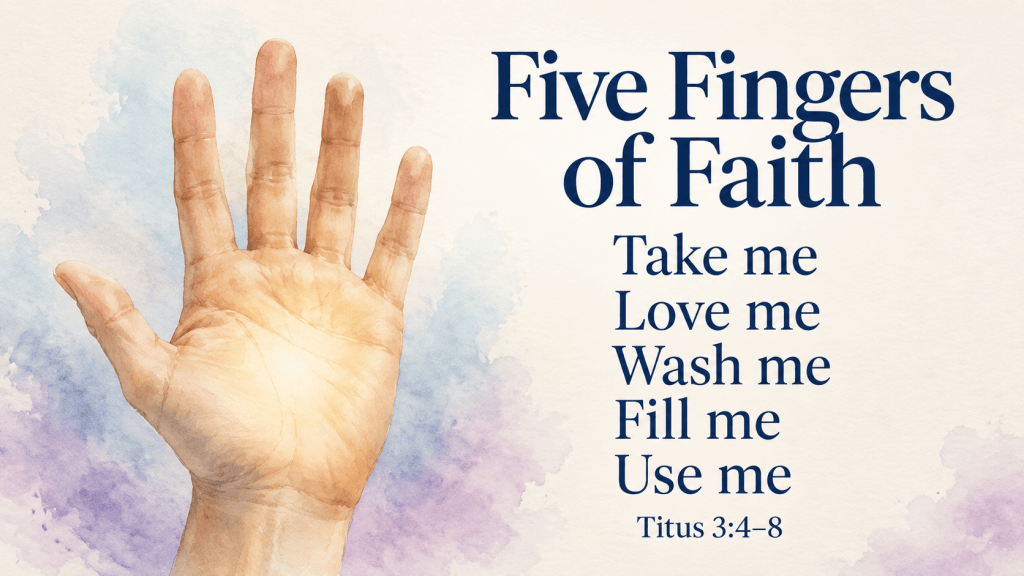
Think about everything that hand has done. It has worked, created, cooked, carried burdens and held the hands of people you love. It may have written notes, played music, tended a garden, knitted, repaired something or rested gently on someone’s shoulder when words were not enough.
Our hands carry part of our story. They can also help us remember a simple prayer:
Take me. Love me. Wash me. Fill me. Use me.
Five fingers. Five prayers. One life placed in the hands of God.
Take Me and Love Me
Titus 3:4–8 begins with the goodness and loving kindness of God. It reminds us that we are saved not because we have done everything right, but because God is merciful.
Our prayer begins with “Take me.”
Take me as I am, Lord—with my gifts and questions, my hope and weariness, my faith and uncertainty. God does not wait for a polished, finished version of us. God meets us here and begins the patient work of shaping who we are becoming.
Then we pray, “Love me.”
This is not an attempt to persuade a reluctant God to care. It is an opening of our hearts to the love God is already giving.
We can become so accustomed to working, helping and meeting expectations that we forget how to receive. Yet a faithful life cannot be lived entirely at the pace of urgency. We need moments when we stop striving and remember that we are loved before we accomplish anything.
Wash Me and Fill Me
Titus speaks of rebirth and renewal through the Holy Spirit. God receives us as we are, but grace does not leave us unchanged.
“Wash me” means bringing our failures, regrets, resentments and wounded places into God’s mercy.
Forgiveness does not mean pretending that harm never happened or allowing harmful behaviour to continue. It means refusing to let yesterday’s pain control tomorrow. God’s grace washes away what keeps us trapped and opens the possibility of a new beginning.
Then we pray, “Fill me.”
Fill me with patience when I am frustrated. Fill me with courage when I am afraid. Fill me with compassion when I am tempted to judge. Fill me with hope when the way ahead is uncertain.
The Spirit also fills the ordinary gifts already present in our lives. Baking can become hospitality. Music can become prayer. A telephone call can become pastoral care. Patient listening can become a place of healing. A handmade gift can become encouragement.
When offered in love, ordinary gifts become ministry.
Use Me
Titus encourages those who trust in God to devote themselves to good works. Notice that good works come after grace.
We do not serve so God will love us. We serve because God already loves us.
“Use me” means making ourselves available to God.
Use my voice to encourage. Use my ears to listen. Use my table to welcome. Use my gifts to strengthen the community. Use my hands to make Christ’s love visible.
Being used by God does not always require something dramatic. Sometimes it means noticing who is missing, who is sitting alone or who is carrying a burden. It may mean making a telephone call, delivering a meal, offering a ride or listening without rushing to provide an answer.
It may mean doing justice, loving kindness and walking humbly with God.
One Open Hand
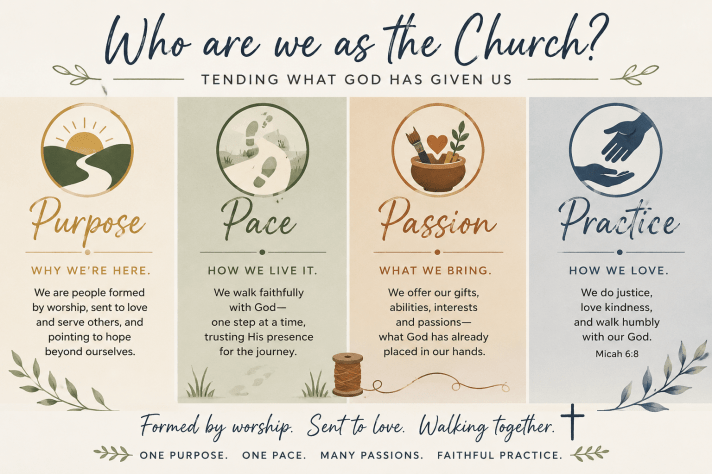
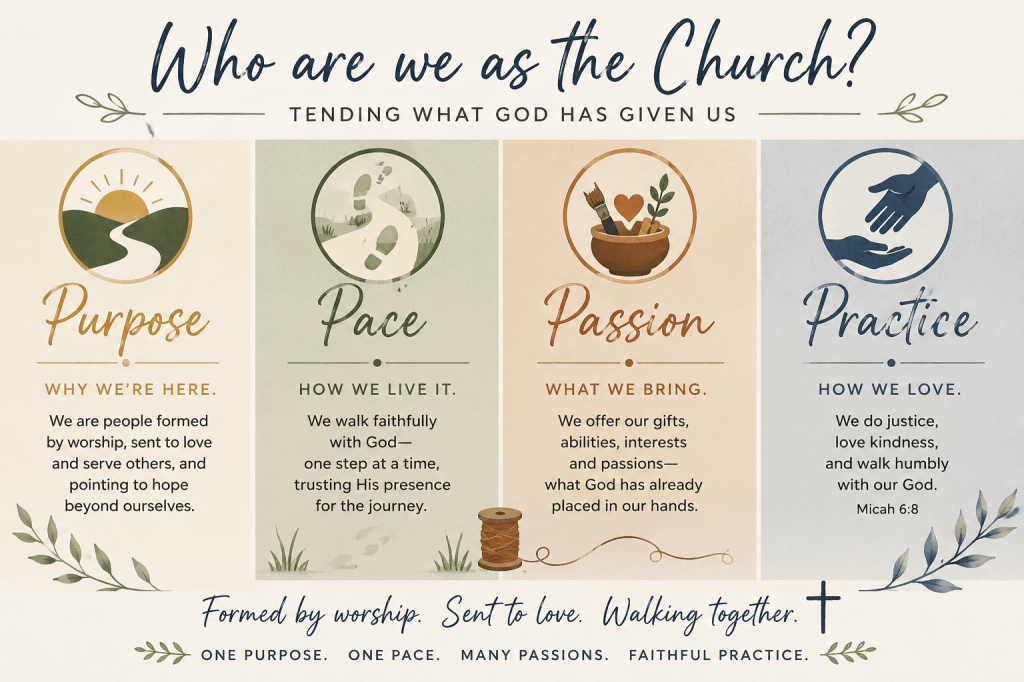
Throughout August, we explored our Purpose, Pace, Passion and Practice as people of faith.
Now those themes can be held together in one open hand:
Take me—my purpose begins in belonging to God.
Love me—I can rest and grow at a faithful pace.
Wash me—I need mercy, forgiveness and a new beginning.
Fill me—the Spirit awakens my gifts and passions.
Use me—faith becomes real when love is put into practice.
This is not only an individual prayer. It is also a prayer for the Church:
Take us, Lord. Love us. Wash us. Fill us. Use us.
Take our congregations and remind us why we are here. Love us through seasons of growth and uncertainty. Wash away old resentments and divisions. Fill us with compassion, courage and hope. Use us so our communities experience the welcome and love of Christ through us.
The Church is a people held in the hands of God, offering our hands in service to the world.
This week, begin each morning by opening your hand and praying:
Take me. Love me. Wash me. Fill me. Use me.
Then watch for the person God places in your path, the gift God invites you to offer and the opportunity to practise kindness.
Place your life in God’s hands—and allow God to place Christ’s love in yours.
Rev. Pastor Barb aka Grannie Doll
Your Invitation This Week
Begin each morning by opening your hand and praying:
Take me. Love me. Wash me. Fill me. Use me.
Then choose one simple way to put that prayer into practice. Encourage someone, listen patiently, share what you have or offer a helping hand.
At the end of the day, ask yourself:
Where did I receive God’s love today—and where did I pass it on?
Forgiveness does not change what happened behind us, but it can change what we carry forward.
Have you ever discovered that you were still carrying something you thought you had put down years ago?
Perhaps someone mentioned a name. You found an old photograph. You returned to a familiar place. A careless remark touched a wound you believed had healed.
Suddenly, the feelings returned.
We can carry hurt for a very long time. We continue working, caring for our families, serving our communities, and getting on with life. Yet somewhere beneath the surface, the pain remains.
Forgiveness is one of the most familiar words in our Christian faith. We pray:
Forgive us our trespasses, as we forgive those who trespass against us.
The words are familiar. Living them is much harder.
Forgiveness sounds simple when we speak about it in general. It becomes more complicated when we attach a name, a face, and a story to it.
In Genesis 45:1–15, Joseph meets the brothers who betrayed him and sold him into slavery. In Matthew 18:21–35, Peter asks Jesus how many times he must forgive someone who sins against him.
Together, these passages show us three movements in the difficult work of forgiveness.
Remember the wound honestly
When Joseph finally stands before his brothers, he does not act as though nothing happened.
Years have passed since they stripped off his robe, threw him into a pit, and sold him. Joseph has survived slavery and imprisonment. Through God’s providence, he has risen to a position of authority in Egypt.
Now his brothers are standing before him.
Joseph has the power to punish them. Instead, he weeps.
His crying is so loud that the Egyptians hear it. This is not a neat, controlled moment. It is grief breaking through after years of silence.
Joseph tells them:
I am your brother, Joseph, whom you sold into Egypt.
He does not say, “It was nothing.”
He does not pretend they were separated through some unfortunate misunderstanding.
Joseph names the wound: “You sold me.”
Forgiveness begins with truth.
Sometimes Christians speak about forgiveness as though faithful people should quickly get over whatever happened. We tell one another to forgive and forget or simply let it go.
But some wounds cannot—and should not—be dismissed so easily.
Forgiveness does not mean pretending cruelty was kindness. It does not mean ignoring injustice, excusing abuse, or returning to an unsafe relationship.
Forgiveness and reconciliation are not the same thing.
Forgiveness may begin within one wounded heart. Reconciliation requires the participation of both people. It needs repentance, accountability, safety, and the slow rebuilding of trust.
Sometimes the most faithful prayer we can offer is simply:
God, this happened. It mattered. And it hurt.
God is not afraid of our honesty. God is not disappointed by our tears. We do not need to cover our wounds with religious language and call that healing.
Joseph weeps before he embraces. He names the betrayal before he speaks about the future.
The journey toward forgiveness begins with remembering the wound honestly.
Receive the grace you need
When Peter asks Jesus how often he should forgive, he suggests seven times. Peter probably believes he is being generous.
Jesus answers, “Not seven times, but seventy-seven times.”
Jesus is not giving Peter a larger number to record in a notebook. He is asking Peter to put away the scorecard.
Jesus then tells a story about a servant who owes a king an unimaginable debt. The servant could never hope to repay it. He falls before the king and begs for more time.
The king does far more than grant an extension. He forgives the entire debt.
This is where Christian forgiveness begins—not with the mercy we manage to offer, but with the mercy we have already received.
Grace comes first.
God knows the whole truth about us: the careless words, the missed opportunities to love, the times we have wounded others, and the choices we wish we could make again.
Yet Christ meets us with mercy.
Grace is not a prize for getting everything right. It is the gift that makes a new beginning possible.
The tragedy in Jesus’ parable is that the forgiven servant does not allow mercy to change him. He leaves the king and immediately demands payment from someone who owes him a much smaller amount.
He has received mercy without becoming merciful.
Forgiveness, however, cannot be manufactured by sheer determination. Some wounds are deep, and healing may take a long time. We may decide to forgive today, only to discover tomorrow that the anger has returned.
Sometimes forgiveness is a moment. More often, it is a practice—something we place into God’s hands again and again.
Perhaps our prayer is not yet, “Lord, I have forgiven.”
It may simply be:
Lord, I want to forgive, but I am not there yet.
Or even:
Lord, I do not want to forgive. Please help me become willing.
God can work with an honest prayer.
Before forgiveness becomes something we offer, it is grace we receive.
Release what you cannot keep carrying
I have been thinking about forgiveness as a tangled piece of yarn.
When yarn becomes knotted, our first impulse may be to pull harder. Usually that only tightens the knot. The more force we use, the more firmly the strands become bound together.
Hurt can work the same way.
We replay the conversation. We imagine what we should have said. We rehearse the injustice. We wait for an apology that may never come.
We may think holding tightly to the hurt keeps the other person accountable. In reality, the other person may have continued with life while we remain bound to the pain.
Forgiveness does not say that what happened was acceptable.
Forgiveness says:
I will not allow what happened to control every part of what comes next.
Joseph eventually recognizes that his brothers’ actions have not been able to defeat God’s purposes. Their betrayal was wrong, but it did not have the final word. God brought life out of a place of suffering and created a future beyond the wound.
This is one of the great promises of our faith: evil does not get to write the final chapter.
What happened may always remain part of our story, but it does not have to become the whole story.
Releasing does not mean abandoning justice. Consequences may remain necessary. Boundaries may need to stay in place. Difficult conversations may still be required.
Releasing means placing judgment into God’s hands.
It means praying:
God, I cannot change what happened. I cannot force another person to understand. I cannot make someone apologize. I cannot repair this by myself. But I can place this person, this memory, and this wounded part of my heart into your hands.
At the cross, Jesus entered fully into the reality of human harm. He was betrayed, falsely accused, humiliated, wounded, and killed.
The cross does not ask us to pretend suffering is unreal. It shows us exactly how real it is.
But the cross is not the end of the story.
The resurrection tells us that betrayal, violence, sin, and death do not have the final word. God can bring life where we believed only endings were possible.
Forgiveness is resurrection work.
It makes room for life to grow in ground hardened by pain. It may not restore the relationship we once had. It may not produce the apology we deserve. It may not happen all at once.
But it can free our hearts from remaining permanently tied to the worst thing that happened.
A question for this week
Perhaps a particular name or memory came to mind as you read this.
Perhaps there is an old conversation you continue to replay.
Perhaps the person you need to forgive is yourself.
Perhaps you need to ask someone else for forgiveness.
You do not have to resolve everything today.
You do not have to pretend the wound was never there.
You do not have to return to an unsafe place.
You do not have to untangle everything by yourself.
But perhaps you can begin with one honest prayer:
Jesus, this is what happened. This is what I am carrying. This is where it still hurts. Help me place it into your hands.
Forgiveness does not change what happened behind us, but it can change what we carry forward.
As we place our tangled stories into Christ’s hands, grace begins its quiet work.
Some of you have seen my spindles before. You know I enjoy spinning. And if you don’t spin, you might look at these and think they all basically do the same thing.
And they do.
But they don’t all do it in quite the same way.
Some are heavier. Some are lighter. Some spin quickly. Others seem happiest with a slower rhythm. This one feels different in my hand from that one.
And I’ve learned that I don’t need every spindle to be the same.
I simply need each one to do what it was created to do.
Maybe there’s something there for the Church.
Paul writes:
“Now there are varieties of gifts, but the same Spirit; and there are varieties of services, but the same Lord.”
Different gifts.
Different people.
Different ways of serving.
But the same Spirit.
1. Recognize What God Has Put in Your Hands
Long before Paul wrote about spiritual gifts, we find a fascinating little story in Exodus.
God is giving instructions for the building of the tabernacle, and God calls a man named Bezalel.
But listen to what God gives him.
Wisdom.
Understanding.
Knowledge.
And—this is the part I love—craftsmanship.
Bezalel can make things.
He knows how to work with his hands.
And Scripture says that ability comes from the Spirit of God.
Sometimes we’ve made the idea of a “spiritual gift” far too narrow.
We think a spiritual gift has to happen in a pulpit, or at a communion table, or in a Bible study.
But what if God has already placed gifts in our hands?
Perhaps you bake.
Perhaps you garden.
Perhaps you repair things.
Perhaps you sing.
Perhaps you knit or sew or paint.
Perhaps you’re the person who remembers to telephone someone who is alone.
Perhaps you make people laugh.
Perhaps you can organize a room full of chaos when everyone else is standing around wondering what to do next.
What if those aren’t simply hobbies or personality traits?
What if they are things God can use?
A spindle sitting on a shelf can be beautiful.
But that’s not its purpose.
It was made to be held.
It was made to turn.
It was made to take what is placed into its care and help transform it into something useful.
Maybe the first question of faith isn’t always, “What should I be doing?”
Maybe sometimes the question is simply:
“Lord, what have you already placed in my hands?”
2. Let the Spirit Bring the Fibres Together
[Take some prepared fibre and gently pull it apart.]
Look at this.
Before it becomes yarn, there are thousands of individual fibres.
On their own, they’re not terribly strong.
I can pull them apart quite easily.
But watch what happens when I add twist.
[Begin spinning.]
The fibres begin catching one another.
They overlap.
They hold onto one another.
And something that was fragile begins to become strong.
Paul says:
“There are varieties of gifts, but the same Spirit.”
That’s what the Spirit does within the Church.
The Spirit doesn’t erase our differences.
The Spirit connects them.
One person has compassion.
Another has practical skills.
Someone else teaches.
Someone sings.
Someone cooks.
Someone understands finances.
Someone quietly notices the person sitting alone.
And Christ takes all those different people and says:
I need you together.
That’s important.
Because sometimes we look at somebody else’s gift and think ours isn’t important.
“I’m not musical.”
“I can’t preach.”
“I’m too old.”
“I’m too shy.”
“I can’t do what I used to do.”
But Paul doesn’t say everyone receives the same gift.
He says:
“To each is given the manifestation of the Spirit for the common good.”
To each.
That means you.
The question isn’t whether you have something to offer.
The question is how the Spirit might connect what you have with what someone else has.
One fibre doesn’t have to become another fibre.
It simply has to become connected.
And together, the fibres become stronger.
Maybe that’s one of the things our churches desperately need to remember.
We don’t have to be alike to belong to one another.
We don’t have to agree about everything to love one another.
We don’t have to have the same abilities to serve beside one another.
Many fibres. One thread. Many gifts. One Spirit. Many people. One body of Christ.
3. Let Love Decide What the Yarn Becomes
Eventually, I end up with this.
Yarn.
But even this isn’t really the end.
Because yarn has a purpose beyond itself.
It can become socks that warm someone’s feet.
A hat for someone who’s cold.
A shawl wrapped around someone’s shoulders.
A blanket.
Something beautiful.
Something useful.
Something given away in love.
And I think this is where our faith has to take us.
Our gifts aren’t given simply so we can say, “Look what I can do.”
They’re given for the common good.
And Paul will eventually take his teaching about spiritual gifts somewhere even deeper.
After talking about apostles and teachers and healers and all these different gifts, he says:
“And I will show you a still more excellent way.”
And then comes 1 Corinthians 13.
Love.
Without love, the gifts don’t mean very much.
That’s ultimately where Christ points us.
Jesus takes everything we have—our talents, our passions, our experience, our time, even the things we do simply because they bring us joy—and asks:
“Can you let me use this to love somebody?”
That’s when a hobby can become ministry.
That’s when an ordinary gift becomes holy.
Not because we put the word “church” in front of it.
But because the love of Christ flows through it.
Maybe that’s the direction we need to be moving as the Church.
Not constantly asking,
“How do we get more people to help with church?”
but asking,
“What do our people already love doing, and how could those things become expressions of Christ’s love?”
Maybe somebody loves gardening.
Could that garden feed someone?
Someone loves baking.
Could that loaf of bread welcome someone?
Someone loves knitting.
Could those needles create comfort?
Someone loves coffee and conversation.
Could that become companionship for someone who’s lonely?
Someone loves fixing things.
Could those hands make life a little easier for a neighbour?
The possibilities are almost endless.
Many Gifts. One Spirit. One Love.
Look at them again.
Different shapes.
Different weights.
Different histories.
Different ways of doing their work.
I wouldn’t want them all to be identical.
And neither does God want God’s people to be identical.
God asks us to bring what we have.
Our gifts.
Our interests.
Our experience.
Our stories.
Our hands.
Our hearts.
And then to allow the Holy Spirit to draw us together.
Fibre by fibre.
Gift by gift.
Person by person.
Until something strong begins to emerge.
Something capable of carrying the love of Christ into the world.
So perhaps this week we could each ask ourselves three questions:
What has God placed in my hands?
Where might my gift connect with someone else’s?
And how could Christ use what I love to help someone know that they are loved?
Because there are varieties of gifts.
There are varieties of ways to serve.
But there is one Spirit.
And underneath it all, holding us together like the twist holds these fibres together, is the love of Christ.
Many fibres. One thread. Many gifts. One Spirit. One love.
And perhaps that is what God is spinning among us even now.
Your Invitation This Week
Take a moment and look at what is already in your hands.
What do you love to do? What comes naturally to you? What brings you joy?
Then ask one more question:
How could I use this gift to share the love of Christ with someone this week?
It doesn’t need to be big. Bake the bread. Make the phone call. Share something from the garden. Knit a few rows for someone who needs warmth. Sit down with someone over a cup of tea and listen.