Doll Can Create

100 Mile Life/Grandma Core

Rooted in Grace: What Are You Ready to Stop Carrying? — August 30, 2026

Rooted in Grace: What Are You Ready to Stop Carrying?

Forgiveness does not change what happened behind us, but it can change what we carry forward.

Have you ever discovered that you were still carrying something you thought you had put down years ago?

Perhaps someone mentioned a name. You found an old photograph. You returned to a familiar place. A careless remark touched a wound you believed had healed.

Suddenly, the feelings returned.

We can carry hurt for a very long time. We continue working, caring for our families, serving our communities, and getting on with life. Yet somewhere beneath the surface, the pain remains.

Forgiveness is one of the most familiar words in our Christian faith. We pray:

Forgive us our trespasses, as we forgive those who trespass against us.

The words are familiar. Living them is much harder.

Forgiveness sounds simple when we speak about it in general. It becomes more complicated when we attach a name, a face, and a story to it.

In Genesis 45:1–15, Joseph meets the brothers who betrayed him and sold him into slavery. In Matthew 18:21–35, Peter asks Jesus how many times he must forgive someone who sins against him.

Together, these passages show us three movements in the difficult work of forgiveness.

Remember the wound honestly

When Joseph finally stands before his brothers, he does not act as though nothing happened.

Years have passed since they stripped off his robe, threw him into a pit, and sold him. Joseph has survived slavery and imprisonment. Through God’s providence, he has risen to a position of authority in Egypt.

Now his brothers are standing before him.

Joseph has the power to punish them. Instead, he weeps.

His crying is so loud that the Egyptians hear it. This is not a neat, controlled moment. It is grief breaking through after years of silence.

Joseph tells them:

I am your brother, Joseph, whom you sold into Egypt.

He does not say, “It was nothing.”

He does not pretend they were separated through some unfortunate misunderstanding.

Joseph names the wound: “You sold me.”

Forgiveness begins with truth.

Sometimes Christians speak about forgiveness as though faithful people should quickly get over whatever happened. We tell one another to forgive and forget or simply let it go.

But some wounds cannot—and should not—be dismissed so easily.

Forgiveness does not mean pretending cruelty was kindness. It does not mean ignoring injustice, excusing abuse, or returning to an unsafe relationship.

Forgiveness and reconciliation are not the same thing.

Forgiveness may begin within one wounded heart. Reconciliation requires the participation of both people. It needs repentance, accountability, safety, and the slow rebuilding of trust.

Sometimes the most faithful prayer we can offer is simply:

God, this happened. It mattered. And it hurt.

God is not afraid of our honesty. God is not disappointed by our tears. We do not need to cover our wounds with religious language and call that healing.

Joseph weeps before he embraces. He names the betrayal before he speaks about the future.

The journey toward forgiveness begins with remembering the wound honestly.

Receive the grace you need

When Peter asks Jesus how often he should forgive, he suggests seven times. Peter probably believes he is being generous.

Jesus answers, “Not seven times, but seventy-seven times.”

Jesus is not giving Peter a larger number to record in a notebook. He is asking Peter to put away the scorecard.

Jesus then tells a story about a servant who owes a king an unimaginable debt. The servant could never hope to repay it. He falls before the king and begs for more time.

The king does far more than grant an extension. He forgives the entire debt.

This is where Christian forgiveness begins—not with the mercy we manage to offer, but with the mercy we have already received.

Grace comes first.

God knows the whole truth about us: the careless words, the missed opportunities to love, the times we have wounded others, and the choices we wish we could make again.

Yet Christ meets us with mercy.

Grace is not a prize for getting everything right. It is the gift that makes a new beginning possible.

The tragedy in Jesus’ parable is that the forgiven servant does not allow mercy to change him. He leaves the king and immediately demands payment from someone who owes him a much smaller amount.

He has received mercy without becoming merciful.

Forgiveness, however, cannot be manufactured by sheer determination. Some wounds are deep, and healing may take a long time. We may decide to forgive today, only to discover tomorrow that the anger has returned.

Sometimes forgiveness is a moment. More often, it is a practice—something we place into God’s hands again and again.

Perhaps our prayer is not yet, “Lord, I have forgiven.”

It may simply be:

Lord, I want to forgive, but I am not there yet.

Or even:

Lord, I do not want to forgive. Please help me become willing.

God can work with an honest prayer.

Before forgiveness becomes something we offer, it is grace we receive.

Release what you cannot keep carrying

I have been thinking about forgiveness as a tangled piece of yarn.

When yarn becomes knotted, our first impulse may be to pull harder. Usually that only tightens the knot. The more force we use, the more firmly the strands become bound together.

Hurt can work the same way.

We replay the conversation. We imagine what we should have said. We rehearse the injustice. We wait for an apology that may never come.

We may think holding tightly to the hurt keeps the other person accountable. In reality, the other person may have continued with life while we remain bound to the pain.

Forgiveness does not say that what happened was acceptable.

Forgiveness says:

I will not allow what happened to control every part of what comes next.

Joseph eventually recognizes that his brothers’ actions have not been able to defeat God’s purposes. Their betrayal was wrong, but it did not have the final word. God brought life out of a place of suffering and created a future beyond the wound.

This is one of the great promises of our faith: evil does not get to write the final chapter.

What happened may always remain part of our story, but it does not have to become the whole story.

Releasing does not mean abandoning justice. Consequences may remain necessary. Boundaries may need to stay in place. Difficult conversations may still be required.

Releasing means placing judgment into God’s hands.

It means praying:

God, I cannot change what happened.
I cannot force another person to understand.
I cannot make someone apologize.
I cannot repair this by myself.
But I can place this person, this memory, and this wounded part of my heart into your hands.

At the cross, Jesus entered fully into the reality of human harm. He was betrayed, falsely accused, humiliated, wounded, and killed.

The cross does not ask us to pretend suffering is unreal. It shows us exactly how real it is.

But the cross is not the end of the story.

The resurrection tells us that betrayal, violence, sin, and death do not have the final word. God can bring life where we believed only endings were possible.

Forgiveness is resurrection work.

It makes room for life to grow in ground hardened by pain. It may not restore the relationship we once had. It may not produce the apology we deserve. It may not happen all at once.

But it can free our hearts from remaining permanently tied to the worst thing that happened.

A question for this week

Perhaps a particular name or memory came to mind as you read this.

Perhaps there is an old conversation you continue to replay.

Perhaps the person you need to forgive is yourself.

Perhaps you need to ask someone else for forgiveness.

You do not have to resolve everything today.

You do not have to pretend the wound was never there.

You do not have to return to an unsafe place.

You do not have to untangle everything by yourself.

But perhaps you can begin with one honest prayer:

Jesus, this is what happened.
This is what I am carrying.
This is where it still hurts.
Help me place it into your hands.

Forgiveness does not change what happened behind us, but it can change what we carry forward.

As we place our tangled stories into Christ’s hands, grace begins its quiet work.

The knot loosens.

The heart begins to breathe.

The roots find room to grow.

And, little by little, new life becomes possible.

Many blessings

Pastor Barb aka Grannie Doll

Purpose, Pace, Passion, Practice: Practising the Life of Christ — August 26, 2026

Purpose, Pace, Passion, Practice: Practising the Life of Christ

Over the past few weeks, I’ve been sitting with one deceptively simple question:

Who are we as the Church?

Not: How many people are sitting in our pews?

Not: How many programs are we running?

Not even: How well are we maintaining our buildings and traditions?

But who are we becoming as followers of Christ?

Four words have emerged as I’ve wrestled with that question:

Purpose. Pace. Passion. Practice.

And together, I think they offer us a way of thinking about what it means to live faithfully—not only on Sunday morning, but throughout the week.

Purpose: Why Are We Here?

We began with purpose.

What is the Church actually here to do?

I keep coming back to three things:

Worship that forms us.
Love that serves others.
Hope that points beyond ourselves.

Worship matters, but worship isn’t supposed to leave us exactly as we arrived.

We gather to be reminded of God’s grace. We listen to Scripture. We pray. We sing. We encounter Christ.

And then we carry what we’ve received into the world.

One of the questions I’ve been asking is:

If our church disappeared tomorrow, what would our community miss?

I’d like the answer to be more than our building.

I’d like them to miss our love.

Pace: We Don’t Have to Hurry

Then we considered our pace.

We live in a culture that constantly tells us to hurry.

Do more. Accomplish more. Grow faster. Fill the calendar.

Churches can fall into that pattern too. We can become so busy doing church that we forget how to be the Church.

But Scripture gives us a different rhythm.

We walk with God.

Not run.

Not race.

Walk.

Faithfulness isn’t measured by how quickly we get somewhere. Sometimes faithfulness means simply taking the next step with God.

One prayer.

One conversation.

One act of kindness.

And then another.

Passion: What’s Already in Your Hands?

Next came passion.

What gifts has God already placed in our hands?

Sometimes we imagine ministry as something done by people with particular religious qualifications. But God’s gifts are wonderfully varied.

Some of us cook.

Some garden.

Some knit, sew, spin or make things.

Some sing.

Some organize.

Some repair things.

Some teach.

Some listen.

Some pray.

Some have the remarkable ability simply to sit quietly beside another person when life hurts.

These are gifts.

The question isn’t simply:

What has God given me?

It’s also:

How can I offer what I’ve been given for the good of someone else?

Practice: Now We Live It

And that brings me to our fourth word:

Practice.

Eventually faith has to leave the page.

Eventually the things we sing, pray and proclaim on Sunday have to become something we live on Monday.

The prophet Micah puts it beautifully:

Do justice.
Love kindness.
Walk humbly with your God.

— Micah 6:8

There’s something important about those verbs.

Micah doesn’t tell us merely to believe in justice.

Do it.

He doesn’t tell us merely to appreciate kindness.

Love it.

And he doesn’t tell us to stand still admiring God from a distance.

Walk with God.

This is faith becoming practice.

Jesus Gives Those Words Faces

Then I turn to Matthew 25.

Jesus speaks about the hungry, the thirsty, the stranger, the person needing clothing, the sick and the imprisoned.

And he says something extraordinary.

When you cared for them, you cared for me.

Suddenly Micah’s words have faces.

Do justice.

There’s a person.

Love kindness.

There’s a neighbour.

Walk humbly.

There’s Christ walking beside us—and sometimes meeting us in the very person standing in front of us.

Micah tells us how to walk. Jesus shows us where that walk will take us.

It takes us toward people.

Tending What God Has Given Us

Someone recently pointed out to me that all of this sounds rather like stewardship.

They’re right.

I haven’t been using that word very much because, in church circles, stewardship can quickly become shorthand for money.

But stewardship is so much bigger than that.

Maybe another way of describing it is:

Tending what God has given us.

Tending our gifts.

Tending our relationships.

Tending our communities.

Tending creation.

Tending our churches.

Tending our faith.

Tending the people God places along our path.

The question becomes less about how much we possess and more about how faithfully we live with what we’ve been given.

That’s Why It’s Called Practice

There’s something else I love about the word practice.

Practice assumes we won’t always get it right.

And we won’t.

We’ll miss opportunities.

We’ll say the wrong thing.

We’ll become impatient.

We’ll get tired.

We’ll become distracted by things that ultimately aren’t very important.

So we practise.

We practise forgiveness.

We practise generosity.

We practise hospitality.

We practise justice.

We practise kindness.

We practise seeing Christ in one another.

And then we return to worship.

We pray again.

We listen again.

We sing again.

We allow Christ to form us again.

And then we’re sent back into the world to practise some more.

Who Are We as the Church?

Perhaps after these weeks of thinking about this question, my answer is becoming a little clearer.

We are people being formed in the way of Jesus.

We are people learning to walk together.

We are people offering the gifts God has placed in our hands.

We are people practising justice, kindness, mercy and love.

Purpose. Pace. Passion. Practice.

They aren’t four separate things.

They’re part of the same life.

And perhaps that’s why worship doesn’t really end when we sing the final hymn and walk out the door.

We leave worship because it’s time to practise what we’ve proclaimed.

So this week, keep your eyes open.

Notice who’s standing in front of you.

Notice what you’re carrying in your own hands.

Notice where a little kindness, justice, mercy or love might be needed.

And remember:

You may just be meeting Christ there.

Many blessings,

Pastor Barb aka Grannie Doll

How I Create a Calm Life When I’m Busy — August 21, 2026

How I Create a Calm Life When I’m Busy

My weekly journal may not look calm at first glance.

There is worship to prepare and lead, a Bible study, meetings, choir practice, household chores, errands, exercise, baking, and online work. Like most people, I have days when one responsibility seems to run directly into the next.

Yet I am learning that a calm life does not have to be an empty life.

Calm comes from knowing where things belong.

When I sit down to create my weekly journal page, I give each day a gentle purpose. Sunday is for worship. Monday is my Sabbath—a day to rest and savour. Tuesday holds study preparation and household tasks. Wednesday brings Bible study and errands. Thursday is shaped by church responsibilities and meetings. Friday offers space for a date, and Saturday is often a day for baking.

Not every week unfolds exactly as I have written it. Life rarely stays neatly inside the boxes we draw for it. Still, creating this rhythm helps me see that everything does not have to happen today.

That thought alone brings peace.

I also keep a short list of daily household tasks: dishes, laundry, floors, the bed, and the bathroom. These are not meant to become a demanding list of expectations. They are simply small reminders of what helps our home feel cared for.

I don’t need to deep-clean the whole apartment every day. I can wash a few dishes, make the bed, sweep one floor, or put on a load of laundry. Small acts of care, repeated gently, keep the house from becoming overwhelming.

I’m also discovering the importance of leaving open space on the page.

There was a time when I might have looked at an empty section of my planner and wondered what else I could fit into it. Now I see that open space differently. It represents breathing room. It gives me somewhere to place an unexpected task, a needed rest, a quiet cup of tea, or a few peaceful rows of knitting.

A full life needs margins.

My journal also helps me protect what matters most. Writing “Sabbath” on Monday is more than adding another task. It is a promise to myself that rest belongs in my week. Adding “date” to Friday reminds me that relationships deserve time too. Writing “bake” on Saturday makes room for something that nourishes both my home and my spirit.

These things are not extras to be squeezed in after the “important” work is finished. They are part of creating a life that feels whole.

When I become busy, my temptation is to move faster. I start thinking about the next three things while I am still trying to finish the first. But hurrying rarely creates peace. More often, it leaves me feeling scattered.

Instead, I am practicing a slower question:

What belongs in this moment?

If I am preparing Bible study, that is where I need to be. If I am washing dishes, I can simply wash the dishes. If I am resting, I do not need to turn rest into another productivity project.

Calm does not come from completing everything. It comes from being present to the life I am living.

My little weekly page—with its handwriting, stickers, bread-patterned tape, and open spaces—is not only a planner. It is a picture of the life I am trying to create: faithful, useful, creative, nourishing, and gentle.

There will always be busy seasons. Ministry, home, family, creativity, and everyday responsibilities will continue to fill my days. But I can choose the pace at which I meet them.

I can give my work a place.

I can allow small tasks to be enough.

I can protect rest before exhaustion demands it.

I can leave room for beauty, baking, conversation, prayer, and the unexpected.

Perhaps a calm life is not a life in which nothing is happening.

Perhaps it is a life in which we know what matters, make room for it, and trust that we do not have to carry the whole week at once.

One day is enough.

One task is enough.

One quiet moment can help steady the whole day.

What gentle rhythm could you add to your week to create a little more breathing room?

A Use-What-I-Have Loaf: Baking Bread with Beans — August 19, 2026

A Use-What-I-Have Loaf: Baking Bread with Beans

Today’s bread began with a simple question: What can I make with what I already have?

I had been reading about Ezekiel bread, inspired by the words of Ezekiel 4:9:

“Take wheat and barley, beans and lentils, millet and spelt; put them in a storage jar and use them to make bread for yourself.”

I didn’t have all those grains in my cupboard, and I wasn’t interested in making a special shopping trip. Instead, I decided to borrow the spirit of the bread: bringing beans and grains together to make something nourishing.

I started with about two cups of cooked mixed beans. I blended them until fairly smooth and then added what I had available:

  • 2 cups cooked mixed beans, puréed
  • ¼ cup rye flour
  • A mixture of white and whole-wheat flour
  • A generous handful of rolled oats
  • 3 tablespoons honey
  • 2 tablespoons olive oil
  • Commercial yeast
  • Warm water and salt

I added the flour gradually, watching and feeling the dough rather than following exact measurements. That is often how bread happens in my kitchen. You begin with an idea, pay attention to what the dough is telling you and adjust as you go.

The dough rose beautifully. The beans gave it substance without making it impossibly heavy. The rye, whole wheat and rolled oats brought their own texture and flavour, while the honey added a gentle sweetness and the olive oil helped create a soft, tender loaf.

As I write this, the bread is cooling on the counter. It looks wonderful, although I’m resisting the temptation to cut into it too soon. Bread needs that cooling time to finish setting inside—even when the smell makes waiting difficult!

This isn’t an exact replica of commercial Ezekiel bread. It is my own cupboard-friendly version: a nourishing loaf made from beans, grains and a willingness to experiment.

There is something deeply satisfying about making good food from what is already close at hand. It reduces waste, stretches the pantry and reminds me that creativity often begins with limits. We don’t always need the perfect ingredients or the perfect recipe. Sometimes we simply need to begin with what we have.

And today, what I had became bread.

A Few Notes for Next Time

Because I measured much of the flour by feel, this loaf may never be reproduced in precisely the same way—and that’s all right. Next time, I may try adding barley or millet flour, lentils or a scattering of seeds.

For now, I’m waiting for the loaf to cool, the kettle is ready, and I’m looking forward to that first slice.

Have you ever made a successful loaf—or an entire meal—by simply using what you already had in the cupboard?

Many Gifts, One Spirit — August 16, 2026

Many Gifts, One Spirit

What Is in Your Hands?

Scripture: Exodus 31:1–6; 1 Corinthians 12:4–7

There are a few things I brought with me today.

Some of you have seen my spindles before. You know I enjoy spinning. And if you don’t spin, you might look at these and think they all basically do the same thing.

And they do.

But they don’t all do it in quite the same way.

Some are heavier. Some are lighter. Some spin quickly. Others seem happiest with a slower rhythm. This one feels different in my hand from that one.

And I’ve learned that I don’t need every spindle to be the same.

I simply need each one to do what it was created to do.

Maybe there’s something there for the Church.

Paul writes:

“Now there are varieties of gifts, but the same Spirit; and there are varieties of services, but the same Lord.”

Different gifts.

Different people.

Different ways of serving.

But the same Spirit.

1. Recognize What God Has Put in Your Hands

Long before Paul wrote about spiritual gifts, we find a fascinating little story in Exodus.

God is giving instructions for the building of the tabernacle, and God calls a man named Bezalel.

But listen to what God gives him.

Wisdom.

Understanding.

Knowledge.

And—this is the part I love—craftsmanship.

Bezalel can make things.

He knows how to work with his hands.

And Scripture says that ability comes from the Spirit of God.

Sometimes we’ve made the idea of a “spiritual gift” far too narrow.

We think a spiritual gift has to happen in a pulpit, or at a communion table, or in a Bible study.

But what if God has already placed gifts in our hands?

Perhaps you bake.

Perhaps you garden.

Perhaps you repair things.

Perhaps you sing.

Perhaps you knit or sew or paint.

Perhaps you’re the person who remembers to telephone someone who is alone.

Perhaps you make people laugh.

Perhaps you can organize a room full of chaos when everyone else is standing around wondering what to do next.

What if those aren’t simply hobbies or personality traits?

What if they are things God can use?

A spindle sitting on a shelf can be beautiful.

But that’s not its purpose.

It was made to be held.

It was made to turn.

It was made to take what is placed into its care and help transform it into something useful.

Maybe the first question of faith isn’t always, “What should I be doing?”

Maybe sometimes the question is simply:

“Lord, what have you already placed in my hands?”


2. Let the Spirit Bring the Fibres Together

[Take some prepared fibre and gently pull it apart.]

Look at this.

Before it becomes yarn, there are thousands of individual fibres.

On their own, they’re not terribly strong.

I can pull them apart quite easily.

But watch what happens when I add twist.

[Begin spinning.]

The fibres begin catching one another.

They overlap.

They hold onto one another.

And something that was fragile begins to become strong.

Paul says:

“There are varieties of gifts, but the same Spirit.”

That’s what the Spirit does within the Church.

The Spirit doesn’t erase our differences.

The Spirit connects them.

One person has compassion.

Another has practical skills.

Someone else teaches.

Someone sings.

Someone cooks.

Someone understands finances.

Someone quietly notices the person sitting alone.

And Christ takes all those different people and says:

I need you together.

That’s important.

Because sometimes we look at somebody else’s gift and think ours isn’t important.

“I’m not musical.”

“I can’t preach.”

“I’m too old.”

“I’m too shy.”

“I can’t do what I used to do.”

But Paul doesn’t say everyone receives the same gift.

He says:

“To each is given the manifestation of the Spirit for the common good.”

To each.

That means you.

The question isn’t whether you have something to offer.

The question is how the Spirit might connect what you have with what someone else has.

One fibre doesn’t have to become another fibre.

It simply has to become connected.

And together, the fibres become stronger.

Maybe that’s one of the things our churches desperately need to remember.

We don’t have to be alike to belong to one another.

We don’t have to agree about everything to love one another.

We don’t have to have the same abilities to serve beside one another.

Many fibres. One thread.
Many gifts. One Spirit.
Many people. One body of Christ.


3. Let Love Decide What the Yarn Becomes

Eventually, I end up with this.

Yarn.

But even this isn’t really the end.

Because yarn has a purpose beyond itself.

It can become socks that warm someone’s feet.

A hat for someone who’s cold.

A shawl wrapped around someone’s shoulders.

A blanket.

Something beautiful.

Something useful.

Something given away in love.

And I think this is where our faith has to take us.

Our gifts aren’t given simply so we can say, “Look what I can do.”

They’re given for the common good.

And Paul will eventually take his teaching about spiritual gifts somewhere even deeper.

After talking about apostles and teachers and healers and all these different gifts, he says:

“And I will show you a still more excellent way.”

And then comes 1 Corinthians 13.

Love.

Without love, the gifts don’t mean very much.

That’s ultimately where Christ points us.

Jesus takes everything we have—our talents, our passions, our experience, our time, even the things we do simply because they bring us joy—and asks:

“Can you let me use this to love somebody?”

That’s when a hobby can become ministry.

That’s when an ordinary gift becomes holy.

Not because we put the word “church” in front of it.

But because the love of Christ flows through it.

Maybe that’s the direction we need to be moving as the Church.

Not constantly asking,

“How do we get more people to help with church?”

but asking,

“What do our people already love doing, and how could those things become expressions of Christ’s love?”

Maybe somebody loves gardening.

Could that garden feed someone?

Someone loves baking.

Could that loaf of bread welcome someone?

Someone loves knitting.

Could those needles create comfort?

Someone loves coffee and conversation.

Could that become companionship for someone who’s lonely?

Someone loves fixing things.

Could those hands make life a little easier for a neighbour?

The possibilities are almost endless.


Many Gifts. One Spirit. One Love.

Look at them again.

Different shapes.

Different weights.

Different histories.

Different ways of doing their work.

I wouldn’t want them all to be identical.

And neither does God want God’s people to be identical.

God asks us to bring what we have.

Our gifts.

Our interests.

Our experience.

Our stories.

Our hands.

Our hearts.

And then to allow the Holy Spirit to draw us together.

Fibre by fibre.

Gift by gift.

Person by person.

Until something strong begins to emerge.

Something capable of carrying the love of Christ into the world.

So perhaps this week we could each ask ourselves three questions:

What has God placed in my hands?

Where might my gift connect with someone else’s?

And how could Christ use what I love to help someone know that they are loved?

Because there are varieties of gifts.

There are varieties of ways to serve.

But there is one Spirit.

And underneath it all, holding us together like the twist holds these fibres together, is the love of Christ.

Many fibres.
One thread.
Many gifts.
One Spirit.
One love.

And perhaps that is what God is spinning among us even now.

Your Invitation This Week

Take a moment and look at what is already in your hands.

What do you love to do? What comes naturally to you? What brings you joy?

Then ask one more question:

How could I use this gift to share the love of Christ with someone this week?

It doesn’t need to be big. Bake the bread. Make the phone call. Share something from the garden. Knit a few rows for someone who needs warmth. Sit down with someone over a cup of tea and listen.

And if you’d like, leave a comment and tell me:

What’s in your hands—and how might God use it?

When You Hit a Roadblock, Keep Moving — August 13, 2026

When You Hit a Roadblock, Keep Moving

Part of my drive to keep things moving forward—and to feel productive—is to find something else to do whenever I hit a roadblock.

Do you ever hit those roadblocks?

Watch to see how I managed my old ipad.

Earlier this week, I was working on my sermon and found myself completely stuck. I kept asking:

Where am I going with this?
Will it connect with anyone?
Where will people see themselves in this story?

Those are important questions because a sermon is more than words on a page. It needs to meet us somewhere in the middle of our real lives. It needs to help us recognize where God is already at work.

I think I finally figured it out—but you’ll have to join me on Sunday to hear where the story led!

Over the past few weeks, we’ve been exploring three important parts of our life together as the church:

  • Our purpose as the church
  • The pace at which we live and grow spiritually
  • The passions and gifts God has placed within us

This Sunday, we’ll focus on that third word: passion.

What moves us? What brings us joy? What abilities, interests and experiences do we have that God might use?

We’ll explore this through three simple movements.

Recognize the Gift

Sometimes we overlook our gifts because they seem too ordinary. We may not think of baking, gardening, knitting, repairing things, organizing, listening or offering hospitality as spiritual gifts.

Yet God often begins with what is already in our hands.

Recognizing our gifts means paying attention to what gives us joy, what comes naturally to us and what others have noticed within us.

Offer the Gift

A gift becomes even more meaningful when it is shared.

That may mean offering something we have made, but it can also mean giving our time, our attention or our presence. Sometimes the most important gift we offer is simply ourselves—the willingness to sit beside someone, listen to their story or help carry a burden.

Connect the Gift

Finally, we’ll consider how our individual gifts connect us with the wider life and work of the church.

We don’t all have the same abilities, interests or passions—and that is a wonderful thing. When each person brings what they have, our separate gifts become part of something larger. Together, they help the church worship, serve, care and reach beyond its walls.

If you’d like to hear how it all comes together, I invite you to join us this Sunday:

9:30 a.m. at Linden Park United Community Church on Hamilton Mountain
11:00 a.m. at Binbrook United Church

The 9:30 service will also be livestreamed on Facebook. I hope to share it on YouTube afterward as well—provided my iPad agrees to cooperate!

For now, I still have today and tomorrow to finish preparing for Sunday. And perhaps that is the lesson within the lesson: when we reach a roadblock, we don’t always need to push harder. Sometimes we need to pause, do something else and allow the next step to reveal itself.

Whatever gift or passion you have to offer the world, I hope you feel free to share it. It may seem small or ordinary to you, but in God’s hands, even the simplest gift can become part of something beautiful.

Have a wonderful day, and God bless.

From Pastor Barb to you—bye for now.

And for those who follow me on YouTube, I’m Doll from Doll Can Create.

I know you can too.

Pace and Rhythm — August 8, 2026
The Stewardship Life: More Than Taking Care — August 7, 2026

The Stewardship Life: More Than Taking Care

There are some words that quietly fade from everyday conversation.

Stewardship is one of them.

For many of us, the word immediately brings to mind church budgets, fundraising campaigns, or managing our finances wisely. Those things certainly have their place, but I have been wondering if stewardship is much bigger than that.

What if stewardship is really about caring well for every gift we’ve been given?

As I look around, I notice that we’re surrounded by messages encouraging us to live a little greener. Some are thoughtful and helpful. Others are simply clever marketing. It’s easy to believe that buying a different product will somehow make us better caretakers of the world.

But I’ve come to believe that the deeper question isn’t what we purchase.

The deeper question is:

What kind of life are we creating?

That question has led me to a new season of reflection.

Over the coming weeks, I’d like to explore what I’m calling The Stewardship Life—a way of living that is rooted in gratitude, shaped by intention, and guided by the belief that everything we have is ultimately a gift from God.

Together we’ll explore four areas of stewardship.

We’ll consider the land that feeds us and how our daily choices connect us with creation.

We’ll spend time in our homes, discovering that cooking, mending, creating, and welcoming others are holy acts of hospitality.

We’ll talk honestly about caring for our bodies with gentleness instead of criticism, remembering that they, too, are gifts entrusted to us.

And we’ll turn our attention inward to the stewardship of our hearts—our thoughts, our relationships, our faith, and the habits that quietly shape our lives over time.

If you’ve followed me for a while, you’ll know this won’t be a polished lifestyle series.

You’ll find me baking bread, spinning wool, knitting socks, visiting local markets, wandering through thrift shops, mending clothes, and enjoying a quiet cup of tea.

Those ordinary moments aren’t the point.

They’re simply the places where I’ve discovered that everyday life can become sacred when lived with care.

My hope is that these reflections won’t leave us feeling guilty for what we haven’t done. Instead, I hope they’ll encourage us to notice what God has already placed in our hands and ask one simple question:

How can I care for this well?

Perhaps that’s what stewardship has always been.

Not striving for perfection.

Not chasing more.

But faithfully tending the gifts we’ve already been given.

I’d be honoured if you joined me as we begin this journey together.

Welcome to The Stewardship Life.

Living with intention, gratitude, and enough.

Grannie Doll

What’s Going On in Grannie Doll’s Kitchen? — August 5, 2026

What’s Going On in Grannie Doll’s Kitchen?

It’s Wednesday, and my kitchen is quietly at work.

The dried beans that soaked overnight are now simmering on the stove. There’s no hurrying them. They will soften in their own good time and be ready for another meal later in the week.

A basket of strawberries is waiting to be washed, trimmed, and tucked into the freezer—a little taste of summer saved for colder days.

Chicken noodle soup is warming in the Instant Pot for lunch, while pork chops thaw for dinner. I’ll cook some rice to go alongside them and perhaps add a vegetable or two. Nothing fancy, but nourishing and dependable.

The dishwasher has been emptied and is ready to be filled again. Isn’t that the rhythm of a kitchen? We empty, wash, cook, eat—and begin once more.

Now it’s time to update the shopping list, taking note of what we’ve used and what we will need for the next few days. Shopping from the kitchen begins by noticing what is already here.

And then there is the bread.

Am I ready to mix a batch today? Possibly.

The flour is waiting. The kitchen is already warm and busy. Perhaps a bowl of dough rising on the counter is exactly what this Wednesday needs.

This is what’s happening in Grannie Doll’s kitchen today: food simmering, summer being saved, supper taking shape, and the ordinary work of home carrying on.

What’s simmering in your kitchen today?

Grannie Doll—keeping the kitchen warm and the pantry ready.

August 2026 — August 1, 2026

August 2026

August has always felt like a threshold to me.

The gardens are full, the tomatoes finally taste like summer, and the evenings arrive just a little earlier than they did in July. We know autumn is still weeks away, but if we’re paying attention, we can already hear it whispering.

This past month has reminded me that ordinary days are often the richest ones. There were hours spent at my spinning wheel during Tour de Fleece, fresh loaves cooling on the counter, swims on warm afternoons, visits to local farm stands, and quiet moments with knitting in hand. None of these moments were particularly remarkable, yet together they became a beautiful reminder that a good life is rarely built from grand events. It’s built from faithful, ordinary days lived well.


From My Kitchen

Sour dough kitchen bread

“One of the highlights of July was trying a new bread recipe using sourdough discard. I almost didn’t change my usual method—I’m a creature of habit—but those two little golden loaves reminded me that sometimes trying something new is exactly what we need…”

Recipe:

100 g sourdough discard

280 g warm water

2 tsp active dry yeast

10 g salt

2 T olive oil

450 g flour – mixture of whole wheat and Canadian AP flour.

Mix and bench rest covered for an hour. Then stretch, fold, knead whatever is your preference but get a good feel for the dough. Shape it into 2 loaves, I like 4 small buns of bread. Cover and rest again for an hour.

Heat oven to 385 F. When ready place in the hot oven. I set the time for 30 minutes. I check the internal temperature of the loaf. If it’s over 200 F then they are ready to come out. Less than that I leave for another 5 or 10 minutes.

I know this may not mesh with other folks ideas of recipes and sour dough bread but it works for me. After making sour dough bread for a few years now this is my go to. Let me know if you try it. There’s lots of room for weeking


A Gentle Morning

“Lately I’ve been beginning my mornings before the world becomes noisy. Coffee first. Journal beside me. A few quiet minutes to breathe, pray, and simply notice the day beginning…” Some mornings I have matcha instead of coffee and most often a warm glass of water with a little lemon to wake up my appetite. I try to create space in the stillness of the day. I’ve often thought, “how I start my day is how my day goes.” What about you?

This month’s gentle practice: Spend five minutes outside before opening your phone.


Around the Studio

Well July meant lots of spinning and of course knitting.

The sweater is growing.
The socks have another few inches. I’ll finish the green socks very soon.
The spinning wheel continues its gentle rhythm. My spindles stand at the ready.

Looking Ahead

“In August I’ll be sharing…”

  • a new YouTube video series on “Mending, Making Do, and More with Less”
  • a favourite seasonal recipe…I haven’t chosen one yet but currently thinking about my Grammie’s fruit relish
  • thoughts from Sunday’s sermon…Since I’m back in the pulpit on Sunday the 2nd I’ll share a short message here each week.
  • knitting updates…of course there will be sock knitting, scarfs on needles, and the sweater
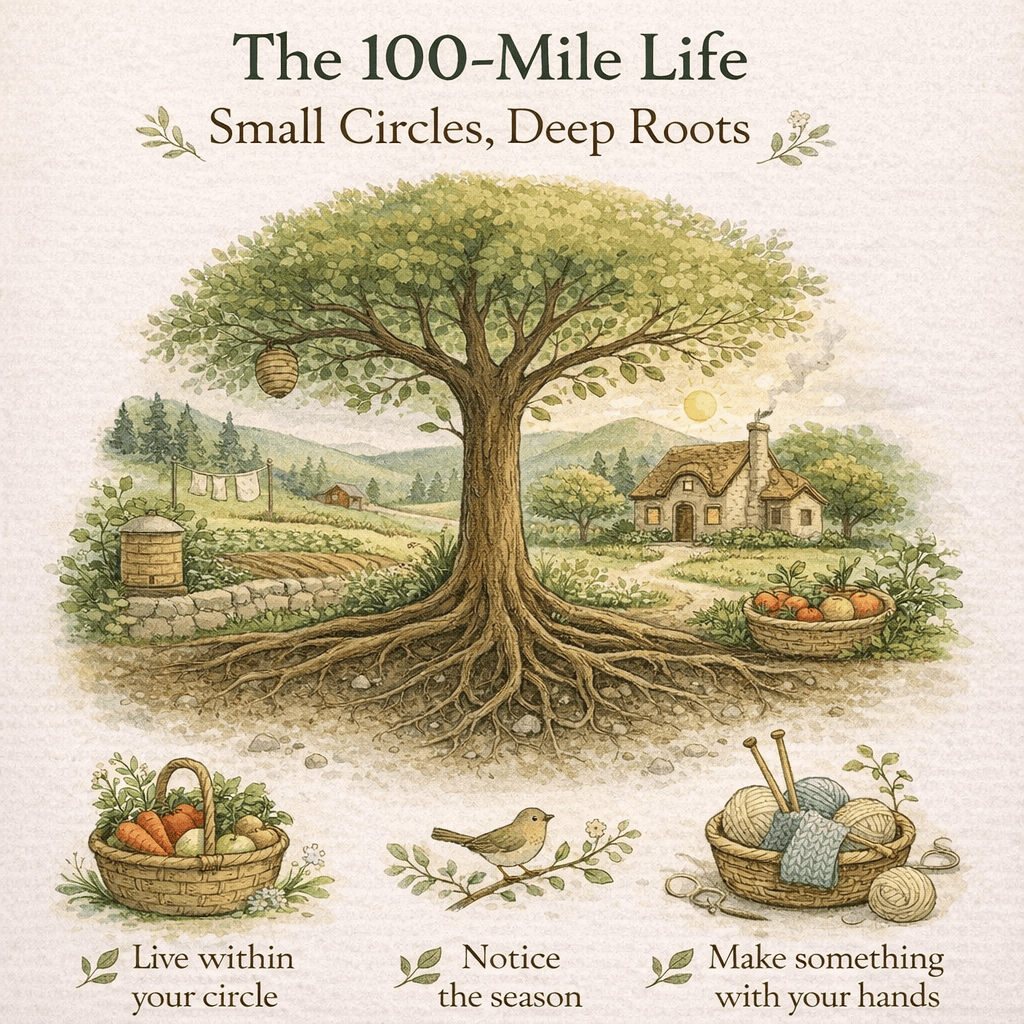
  • slow living reflections…lots of writing and sharing about daily life living 100 miles, deep roots

A Word for August

I was reminded recently of one of my favourite passages of Scripture:

“For everything there is a season, and a time for every matter under heaven.”
— Ecclesiastes 3:1

August always brings those words to mind.

The late summer perennials are putting on one last glorious display of colour. Gardens and farm stands overflow with the abundance of the harvest. Tomatoes are at their sweetest, baskets are full, and the shelves begin to fill with back-to-school supplies.

And, if you’ve been in the shops lately, you’ve probably noticed something else—Halloween decorations have already begun to appear. A little too early for my liking!

There is always a temptation to hurry into the next season before we’ve fully lived the one we’re in. But perhaps Ecclesiastes offers us a gentler invitation: to receive each season as a gift, without rushing ahead.

So, let’s savour August.

Let’s enjoy the warmth of the sun, the freshness of garden vegetables, evenings on the porch, quiet mornings with a cup of tea or coffee, and the simple rhythms that nourish our hearts.

August has so much potential—not because we fill every day with activity, but because we choose to be present for the season we have been given.

May you find joy in these summer days and give thanks for the season you are in.

For now,

May your kettle always be warm, your hands find meaningful work, and your heart remember that even the smallest circles can grow deep roots.

Blessings,
Grannie Doll 🌿

Thank you for sharing with your friends.