Doll Can Create

100 Mile Life/Grandma Core

Low-Fat Potato Leek Soup: Comfort in a Bowl — October 20, 2025

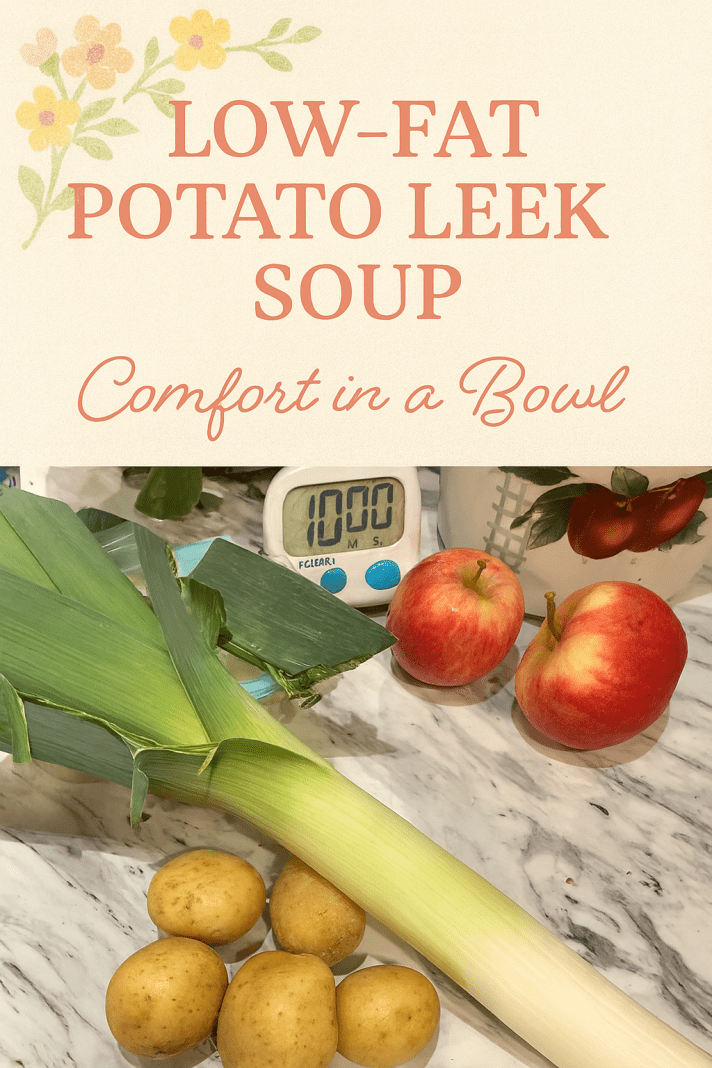
Low-Fat Potato Leek Soup: Comfort in a Bowl

From Grannie Doll – 100 Mile Kitchen

There’s something so deeply comforting about a bowl of homemade soup simmering on the stove. The scent of leeks softening fills the kitchen. Potatoes gently bubbling create a soothing sound. A touch of salt in the air brings me back to simpler days. Supper was warm, nourishing, and made with love.

This low-fat potato leek soup keeps all that old-fashioned coziness but lightens the load a bit. It’s smooth, creamy, and delicious — yet easy on the waistline and kind to the heart. Perfect for anyone wanting comfort food that still fits into a mindful eating plan.

As part of my 100 Mile Life, I’ve been leaning into local ingredients more than ever. Leeks from the farmers’ market combine with potatoes from a nearby farm stand. Even local milk or oat milk from our region adds to create something wholesome and rooted in place.


🌿 Why I Love This Soup

Soup season, for me, isn’t just about food — it’s about slowing down.
There’s something spiritual in stirring a pot, tasting, adjusting, and waiting. Cooking becomes a quiet rhythm of prayer. It is full of gratitude for the earth that grew the food. It includes appreciation for the hands that harvested it, and for the home that receives it.

And truly, when you can make a soup that’s rich and velvety, it feels like a small miracle. You don’t even need cream or butter.


🥣 The Recipe: Low-Fat Potato Leek Soup

Serves: 4–6
Prep Time: 15 minutes
Cook Time: 30 minutes

Ingredients
  • 2 large leeks (white and light green parts only), cleaned and sliced
  • 1 small onion, diced
  • 3 medium potatoes, peeled and cubed
  • 4 cups low-sodium vegetable or chicken broth
  • 1 cup skim milk or unsweetened oat milk
  • 1 tbsp olive oil or cooking spray
  • 1 bay leaf
  • Salt and pepper to taste
  • Optional garnish: chopped fresh chives or parsley

Directions

  1. In a large pot, heat olive oil and sauté leeks and onion for 5–7 minutes, until soft.
  2. Add potatoes, bay leaf, and broth. Bring to a boil, then reduce to a simmer for 20–25 minutes.
  3. Remove bay leaf. Blend until smooth (immersion or blender).
  4. Stir in milk and heat gently — don’t boil. Season to taste.
  5. Garnish with herbs and enjoy warm.

💡 Add a handful of cooked cauliflower before blending for extra creaminess without fat.
🍞 Pair with a slice of homemade tea biscuit or local bread for a full 100-Mile meal.


💭 A Final Reflection

It’s easy to think of soup as “just food.” However, it’s also a form of grace. It’s a way of tending to body and soul.
Each spoonful reminds me that comfort doesn’t have to be complicated. Sometimes, the best things are local, humble, and made with heart.


If you try this recipe, I’d love to hear from you!
Leave a comment below or tag your post #100MileLife or #GrannieCoreKitchen so we can share our stories of slow, local, loving food together.

Until next time,
💗 Grannie Doll
Living Local. Creating with Love. Finding Grace in the Everyday.
Harvest Apple Salad: A Simple Taste of Autumn — October 14, 2025

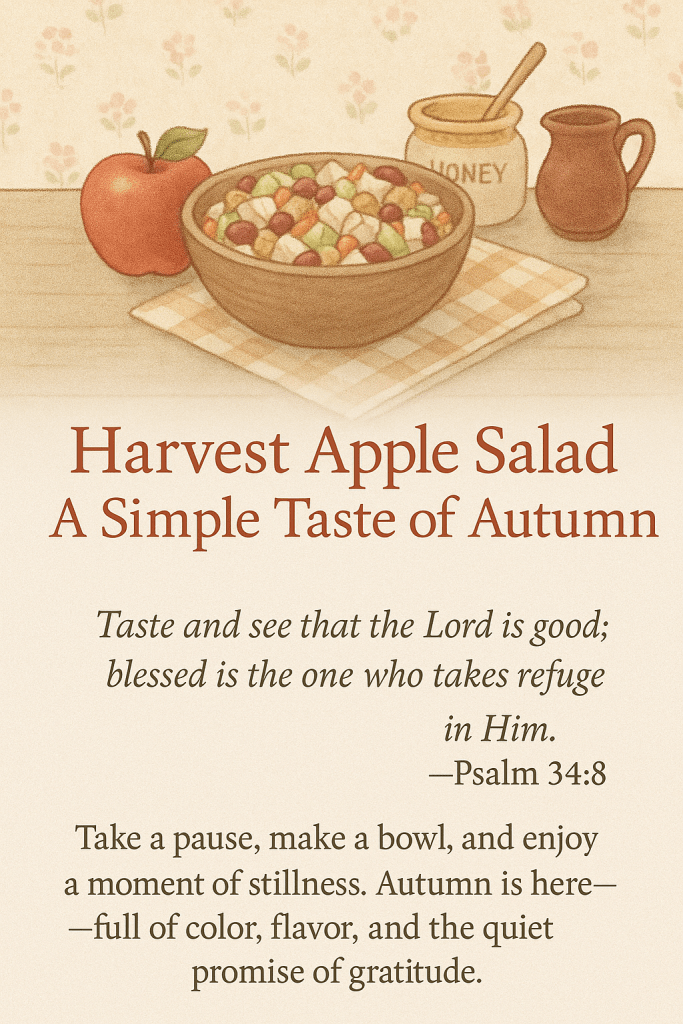
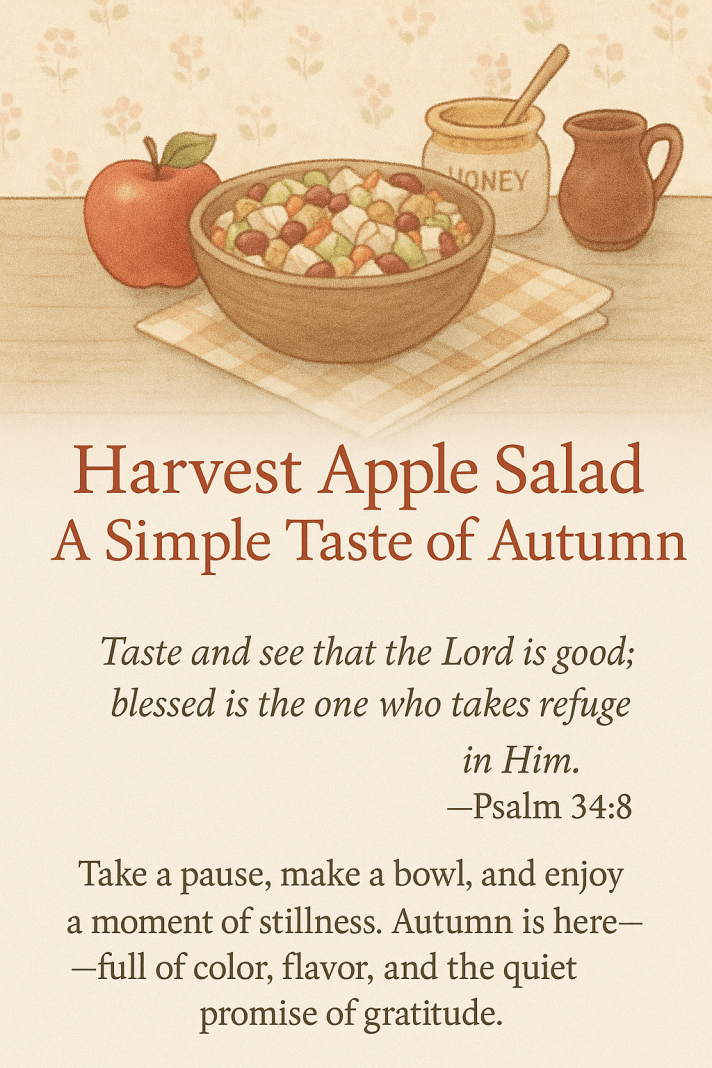
Harvest Apple Salad: A Simple Taste of Autumn

A 100 Mile Life Recipe – see below

There’s something beautiful about the way apples signal the turning of the seasons. The air turns crisp, sweaters return to the chair by the door, and the scent of cinnamon fills the kitchen. That’s when this simple Harvest Apple Salad shines — a bowl of gratitude, sweetness, and crunch.

I love recipes that remind us how enough can be found in what’s near. Local apples, a drizzle of honey, and a handful of nuts from last fall’s pantry are enough. Nothing fancy, just real food grown close to home. That’s what the 100-Mile Life is all about: savoring the beauty of what’s already around us.

This salad comes together in minutes, but somehow feels like a celebration. Each bite carries a little story. It tells of the orchard down the road. It speaks of the bees that made the honey, and the hands that harvested the grain. It’s a taste of home, of community, and of the Creator’s goodness.

“Taste and see that the Lord is good; blessed is the one who takes refuge in Him.” — Psalm 34:8

Take a pause, make a bowl, and enjoy a moment of stillness. Autumn is here — full of color, flavor, and the quiet promise of gratitude.

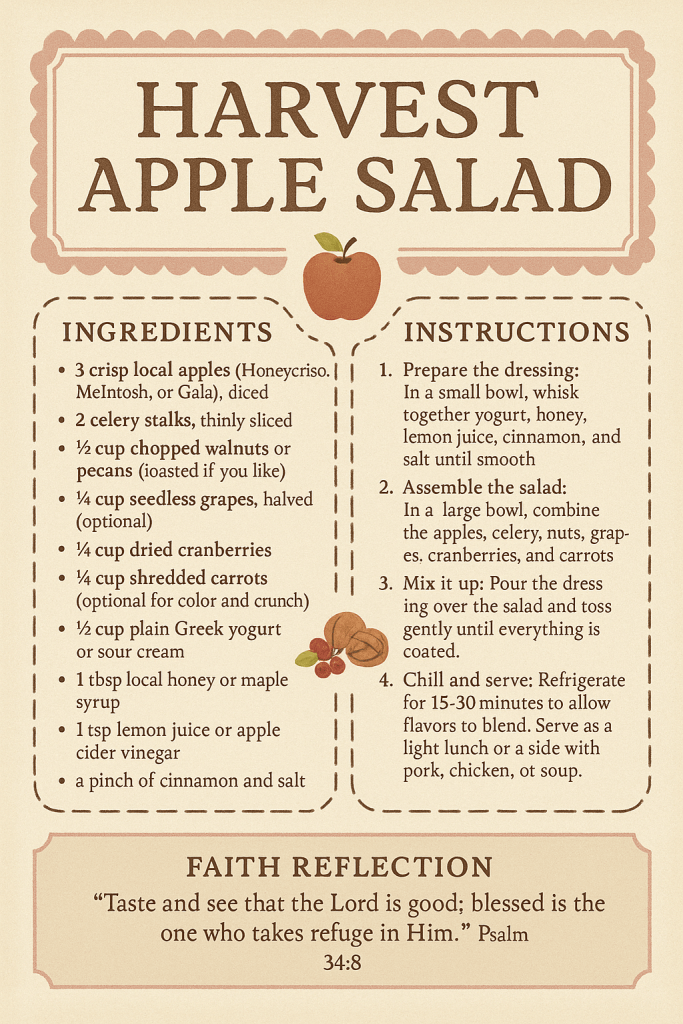
Harvest Apple Salad

Serves: 4
Prep Time: 10 minutes
Total Time: 15 minutes

🧺 Ingredients

  • 3 crisp local apples (Honeycrisp, MacIntosh, or Gala), diced
  • 2 celery stalks, thinly sliced
  • ½ cup chopped walnuts or pecans (toasted if you like)
  • ½ cup seedless grapes, halved (optional)
  • ¼ cup dried cranberries
  • ¼ cup shredded carrots (optional for color and crunch)
  • ½ cup plain Greek yogurt or sour cream
  • 1 tbsp local honey or maple syrup
  • 1 tsp lemon juice or apple cider vinegar
  • A pinch of cinnamon and salt

How many of these ingredients are 100 Mile for you?


🥣 Instructions

  1. Prepare the dressing:
    In a small bowl, whisk together yogurt, honey, lemon juice, cinnamon, and salt until smooth.
  2. Assemble the salad:
    In a large bowl, combine the apples, celery, nuts, grapes, cranberries, and carrots.
  3. Mix it up:
    Pour the dressing over the salad and toss gently until everything is coated.
  4. Chill and serve:
    Refrigerate for 15–30 minutes to allow flavors to blend. Serve as a light lunch or a side with pork, chicken, or soup.

🌿 Variations

  • Add protein: Stir in diced cooked chicken for a hearty meal.
  • Make it vegan: Swap yogurt for coconut yogurt and honey for maple syrup.
  • Add greens: Serve on a bed of spinach or kale for extra freshness.

💛 Faith Reflection

“Taste and see that the Lord is good; blessed is the one who takes refuge in Him.” — Psalm 34:8

A simple salad can remind us how God’s abundance shows up in small, local ways. It is the orchard down the road, the honey from a neighbor’s hive, or the walnuts gathered last fall. Each bite carries a story of care and connection.

Enjoy!

For more information on the 100 Mile Life click here:

©Created in Doll’s Kitchen

Live Thankfully, Love Locally — October 11, 2025

Live Thankfully, Love Locally


Discover how gratitude and faith can reshape your daily choices. This Thanksgiving, learn to live thankfully and love locally — nurturing community, faith, and simplicity within your 100-mile circle.


By Grannie Doll | DollCanCreate

The air turns crisp. The scent of cinnamon drifts from the kitchen. I’m reminded that gratitude is more than a feeling. It’s a way of life.
This Thanksgiving, I’m learning that to live thankfully means noticing the simple gifts around me. To love locally is to cherish the hands and hearts that make them possible.

🍎 Thankfulness in the Everyday

Gratitude doesn’t always arrive wrapped in grand moments.
The morning light on a freshly baked loaf of bread can bring gratitude. The soft hum of a spinning wheel or the laughter shared over a home-cooked meal can also evoke this feeling.
When we live thankfully, we slow down long enough to see how much we’ve already been given. The small becomes sacred.

“Give thanks to the Lord, for He is good; His love endures forever.”
— Psalm 107:1

🧵 Loving Locally

Loving locally means embracing what’s near. It includes buying from the farm stand down the road. You might choose wool from a shepherd you know by name. It could also mean supporting the little shop that remembers your favorite tea.
It’s about more than economics—it’s about belonging. Every local choice becomes a prayer of connection, a way of saying, “I see you. I value you. We’re in this together.”

When we love locally, we weave ourselves into the fabric of community. We become part of God’s quiet work of restoration—one handmade loaf, one kind word, one shared harvest at a time.

🕯 A Faithful Thanksgiving

This season, let’s make gratitude our posture and generosity our practice.
Let’s cook with local ingredients and bless the farmers who grew them. Let’s give thanks for wool, for warmth, for the steady rhythm of creation that provides what we need.
Let’s live thankfully—and love locally—because both are acts of faith.

“And whatever you do, whether in word or deed, do it all in the name of the Lord Jesus, giving thanks to God the Father through Him.”
— Colossians 3:17

🌻 A GrannieCore Reflection

To live thankfully is to dwell in grace.
To love locally is to live it out.
Together they form a rhythm—slow, simple, sacred—that brings us back home to God’s abundance.


Reflection
What’s one way you can love locally this week—through your shopping, your crafting, or your kindness?


With wool, warmth, and gratitude,
💛 Grannie Doll


The 100 Mile Life Guide: A Faith-Filled Journey Toward Simple, Local, and Grateful Living — October 9, 2025

The 100 Mile Life Guide: A Faith-Filled Journey Toward Simple, Local, and Grateful Living

🌾 The 100 Mile Life Guide

A Journey of Faith, Simplicity, and Local Living

💛 What if everything you needed was already within 100 miles of home?

The 100 Mile Life Guide is more than a book — it’s an invitation.
An invitation to slow down, live gratefully, and rediscover abundance right where your feet touch the ground.

This heartfelt, faith-centered guide weaves together stories, reflections, and practical steps for living close to home. It covers sourcing local food and fiber. It also includes finding Sabbath rhythms and crafting with the land. Additionally, it focuses on nurturing a gentle, grateful spirit.


🌿 Inside You’ll Find:

My Why: A 100 Mile Life – The story that started it all
🏡 Heart and Home – How GrandmaCore values bring warmth and wisdom back into daily life
🧺 The 100 Mile Closet – Building a wardrobe of place and purpose
🍲 The 100 Mile Kitchen & Craft Table – Cooking, creating, and connecting with your local circle
🌤️ Rhythms of Rest – Practicing Sabbath and sacred slow living
🤝 Living Generously Within Our Circle – Giving, sharing, and trading the way our grandmothers did
🍎 Appendix of Recipes – Simple, wholesome dishes to fill your home with the scent of gratitude:
• Harvest Soup
• Hearty Breakfast Bowl
• Vegetable Bean Casserole
• Simple Country Bread
• Tea Biscuits
• Harvest Apple Crisp


🌸 Who This Book Is For:

This guide is for the homemaker, the crafter, the faithful soul seeking peace in the ordinary.
It’s for those who want to live simply. They shop locally and nurture community. They do this without losing heart in a hurried world.

If you’ve ever longed for a slower, more meaningful way to live — this book was written for you.


🙏 Why It Matters:

In a time when everything feels uncertain, life can feel distant. The 100 Mile Life reminds us that we are surrounded by God’s provision. It is in the fields, the farms, and the friendships nearby.
When we live gently within our means and miles, we find joy again in the little things. These include a home-cooked meal, a hand-knit shawl, and a shared harvest table.


🕊️ What Readers Are Saying:

“This book feels like a warm cup of tea with a wise friend.”
“Every page reminded me that living simply is living richly.”
“It helped me rediscover peace right in my own kitchen.”


🌼 Get Your Copy Today

Bring calm, faith, and connection back into your home.
The 100 Mile Life Guide will inspire you to live slower. It encourages you to live deeper. Appreciate the place you call home with gratitude.

👉 [Download the eBook Now]
Available in PDF and printable A5 format.

Thank you for your support of my work.


💛 From Grannie Doll

“Keep your kettle warm, your hands busy, and your heart steady in grace.
May your days be simple, your circle be kind, and your spirit rest in the goodness that’s all around you.”

With wool, wonder, and gratitude,
💛 Grannie Doll

Transformative Journey: Reflections on the 30-Day 100 Mile Challenge — October 4, 2025

Transformative Journey: Reflections on the 30-Day 100 Mile Challenge

I didn’t have a perfect plan when I began the 30-Day 100 Mile Life Challenge. I also did not spend weeks preparing. I simply felt the nudge to start. The “why” was clear. The shifting world situation contributed to this. Rising transportation costs also played a role. There was the fragility of small businesses. Additionally, my own wish to play a meaningful part in shaping a more sustainable way of living was important.

Starting With “Why”

At first, my preparation was simple—pulling out a map and drawing that 100-mile (120-kilometer) circle around my home. That radius became both a boundary and a guide. From there, I peeked into my pantry with fresh eyes: What do I really need? What do I do without? And most importantly, how can I source what I do need? How can I do this in a way that strengthens both my household and my community?

Shifts in Awareness

One of the biggest transformations has been in my awareness. I no longer glance at labels occasionally; now, it’s a daily habit. Where was this made? Who raised the animals? Does this company run ethically? Does my buy ripple out to support my local world rather than drain from it? These questions are no longer optional—they’re part of how I live.

Even my refrigerator and freezer tell a different story now. Instead of stockpiling “just in case,” I choose foods that nourish both my body and my values. Each item feels less like clutter and more like an intentional choice.

Facing the Challenges

Of course, challenges surfaced. Budget-wise, not every local product fits comfortably into a monthly plan. And then there’s the reality that bananas and oranges will never grow in Ontario soil. Still, I found that most of what I buy can be sourced close to home. And honestly? That feels like a victory.

This journey also reminded me of my grandmother’s way of life. Granny knew her household budget well. Yet, she relied on milkmen and delivery services for staples like eggs and bread. I feel like I’ve stepped back into that rhythm. Grocery deliveries and milk arrive at the door. This occurs with the modern convenience of online ordering. This allows me the gift of slowing down and checking origins carefully.

The “Grannie Core” Connection

Part of this journey has been living out what I lovingly call a Grannie core life. I create a cozy home with what I already have. This means I avoid filling my house with “new” at every turn. It means rethinking my wardrobe. I turn to thrift shops before malls. I pull out fabric for sewing projects. I resist the lure of fast fashion.

Fiber arts are another layer. I promised myself I wouldn’t buy yarn or fiber unless it was locally sourced. I stumbled once, with cotton, but the experience reminded me why I love wool and why local matters. Staying away from craft fairs has been hard. Nonetheless, it has also freed me to truly appreciate the stash I already own.

The Emotional Impact

Emotionally, the month surprised me. I expected more frustration, more longing for things I “couldn’t” have. Instead, I felt joy—especially when I discovered a local choice that fit beautifully into my challenge. More than anything, the transition felt smoother than expected. That gives me hope that this isn’t a fad, but a way of life.

What’s Next?

So, what’s next now that I’ve crossed day 31? For me, the 100 Mile Life doesn’t stop. This is more than a challenge—it’s a lifestyle I want to deepen. I’ll keep tightening my circle, keep making better choices, keep asking the hard questions.

This month has shown me that living within 100 miles isn’t about limitation. It’s about connection—to the land, to my community, to the wisdom of those who came before. And that feels like a gift worth carrying ahead.


Reflection Question for You:
Have you ever tried living within a “circle of enoughness”—whether through food, clothing, or crafts? What did you learn from it?

💌 As always, thank you for sitting with me in this cozy corner of life. May you find joy in small, local things today.

From my rocking chair to your home,

Grannie Doll

Why Source Wool Locally? — September 23, 2025

Why Source Wool Locally?

Unboxing Provenance Fibre Club

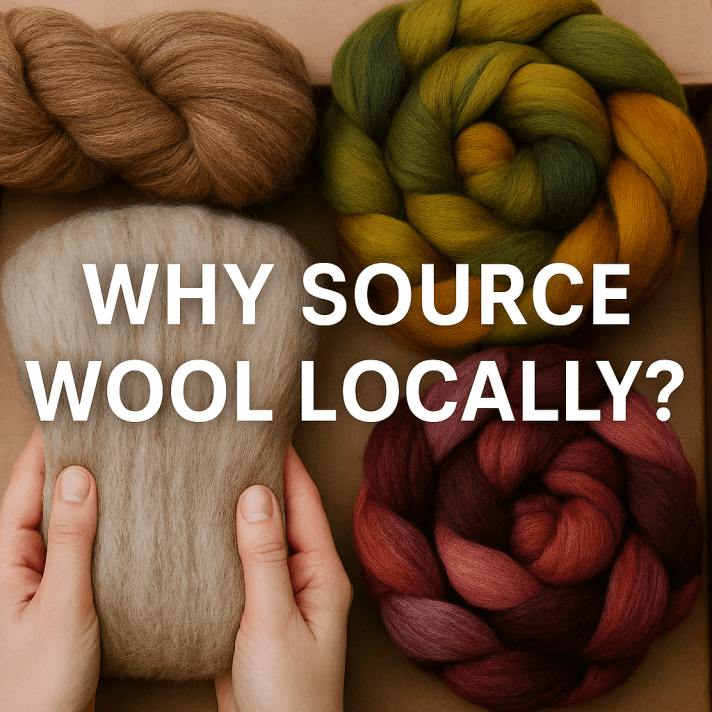
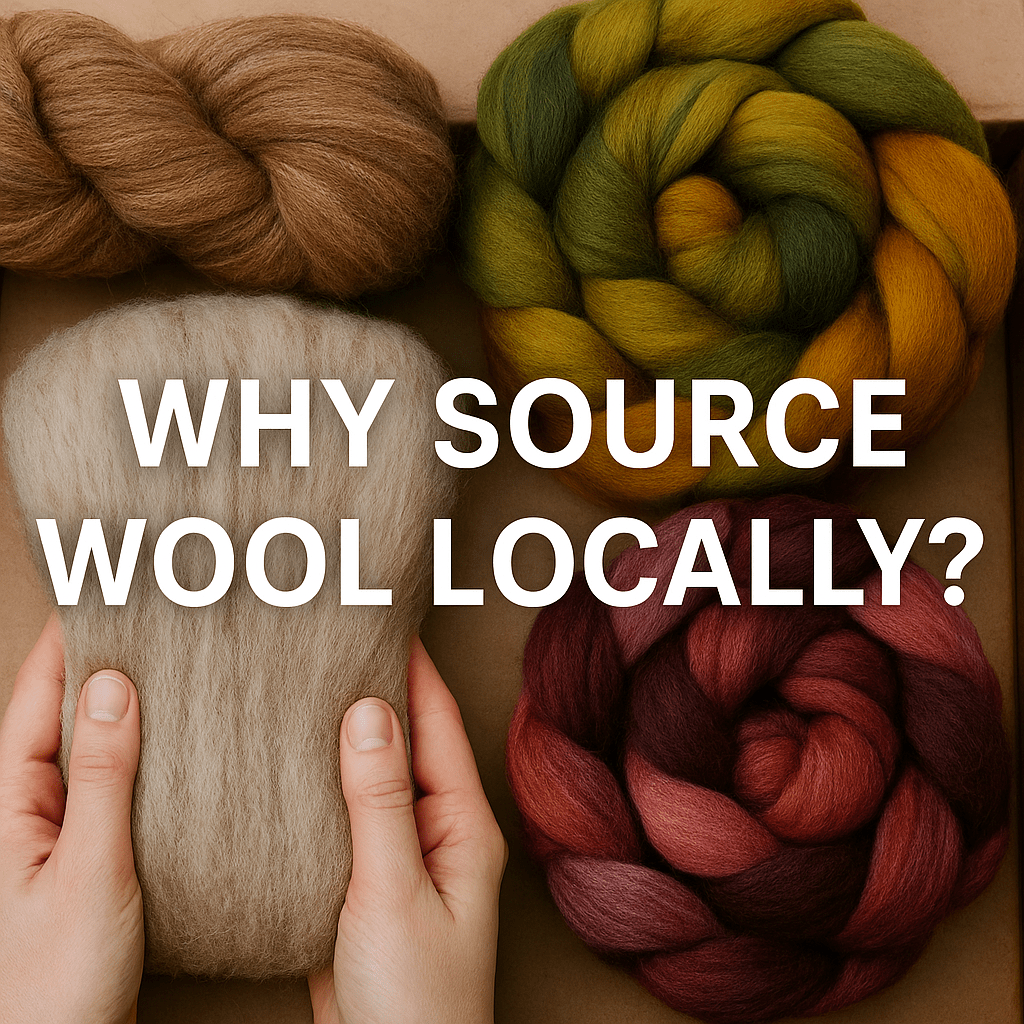
There’s something magical about opening a box of fibre. The colours, the textures, the promise of what it will become. When my Provenance Fibre Club subscription from Julia arrived, I couldn’t wait to dive in. Each braid held not just fibre—but a story.

As I unwrapped each treasure, I felt my excitement grow. But it also reminded me of the bigger question: why source wool locally?


Connection to Place

When we choose local fibre, we’re literally spinning the land around us. Each lock carries the imprint of the farm, the fields, and the seasons. It’s a way of holding our home in our hands.

Supporting Farmers and Makers

Behind every fleece is a shepherd who has cared for those animals through storms and sunshine. By sourcing locally, we honour their work and help keep small farms thriving.

Sustainability

Local wool travels fewer miles to reach us. That means less fuel, less packaging, and a gentler footprint on the earth. It’s one small but meaningful way to live in harmony with our values.

Unique Character

Local breeds raised in particular climates develop distinct textures and qualities. These fibres can’t be replicated elsewhere—they are one-of-a-kind.

Storytelling

Every skein spun from local wool carries a story. It’s not just yarn—it’s the voice of the farm, the shepherd, and the land. When we knit or weave, we share that story with others.


As I spin through my Provenance Fibre Club box, I imagine: this is more than fibre. It’s connection, sustainability, and creativity wrapped up together.

If you’ve never tried local wool, let this be your invitation. Visit a nearby farm, sign up for a local fibre club, or swap with a neighbour. Discover the joy of spinning stories that belong to your own backyard.

Every skein has a story, and every stitch holds a place. May your fibre journey keep you rooted, keep you warm, and keep you close to home. Until next time, spin gently and live locally.

Grannie Doll

Why Wool Matters 🐑🌿 — September 22, 2025

Why Wool Matters 🐑🌿

Today, as I sit with my knitting in hand,

I reflect on a fiber that has been part of my life for so long. That fiber is wool. It may seem like a simple thing. It is a skein of yarn spun from a sheep’s fleece. Nevertheless, for me and for many of us living closer to the land, wool carries a story that’s worth telling.

Wool Is Local

When I choose wool from nearby farms, I’m not just buying yarn. I’m supporting shepherds, small mills, and rural communities who care for their flocks with dedication. Each skein connects me to the fields, pastures, and farmers within my 100-mile circle.

Wool Is Sustainable

Wool is renewable, biodegradable, and natural. Unlike synthetic fibers that linger in landfills, wool eventually returns to the soil, nourishing it. It’s a beautiful example of creation’s design—what’s given to us can also be returned with care.

Wool Is Practical

It’s warm in winter, breathable in summer, and it resists odours in ways synthetic fibers can’t match. A well-made wool garment can last for decades, passed down through families like a quilt of memory and comfort.

Wool Is Comfort

For me, spinning, knitting, or simply handling wool has always been calming. It quiets my racing thoughts and steadies my heart. In every stitch, there’s a prayer. There’s a rhythm of stillness. It connects me to God’s peace and the slow work of my hands.


A Gentle Reminder

Wool is important for many reasons. It is more than a material. It signifies a way of living simply. It involves caring for the earth and honoring those who bring it to us. When we wrap ourselves in wool, we wrap ourselves in connection.


💬 Let’s Talk

Do you have a favorite wool story? Maybe a cozy blanket, a beloved sweater, or even a project on your needles right now? Share it in the comments—I’d love to hear!

👉 If you’d like to follow along on this journey of slow, local living, make sure you’re subscribed. Subscribe to my YouTube channel to stay updated. Subscribing will keep you updated on new content. I share each day of the 30-Day 100 Mile Life Challenge there. Together, we’re discovering that living closer to home brings us closer to what really matters.

🌸 With gratitude, living life 1 stitch at a time,
Grannie Doll

The Challenges of Living a 100-Mile Life 🌿 — September 18, 2025

The Challenges of Living a 100-Mile Life 🌿

When I first began

this 100-Mile Life journey, I knew it would be an adventure. It would be full of discoveries, creativity, and connections with local growers and makers. What I didn’t fully realize was just how many little challenges would rise up along the way. Each one has stretched me, sometimes frustrated me, and often surprised me. But they’ve also shaped this path into something deeper than just “buying local.”


🌱 Food & Meal Planning

One of the first things I noticed was how much my pantry had to change. Foods I once took for granted—bananas, coffee, rice—suddenly became special luxuries I had to think twice about. Planning meals meant paying close attention to the seasons. Strawberries in June are heavenly. Come January, I’d better have canned or frozen some if I want to taste summer sweetness.

It takes more work to preserve, to store, and to plan. But in that effort, I’ve found a rhythm of gratitude. Every jar of tomatoes in my cupboard feels like a victory.


🧶 Fiber & Clothing

Then there’s my love of wool and fiber arts. Finding local wool has been a joy, but it also comes with hurdles. Some farms don’t produce enough to supply bigger projects, and local mills are fewer than you’d think. If I want to spin or knit a sweater, it takes patience. I need to piece together skeins from different sources. I will also learn to work with blends I wouldn’t have chosen before.

Yet, those limitations have taught me something precious. The garment on my needles has a story. It is tied to my land, my hands, and my community.


🏡 Household & Lifestyle

I’ve also had to rethink the everyday items I once bought without a second thought. Spices, oils, cleaning supplies—many don’t come from within 100 miles. Some I can substitute, some I can make, and some I simply go without. Convenience has shifted too. There’s no longer quick trips to the big box store. Now it means going to farmers’ markets, local shops, or even a neighbor’s porch.


💰 Budget & Sustainability

Another challenge is the cost. Buying from small farms and artisans often means paying a little more. But here’s the flip side: That money goes straight into my community. It supports real people I can actually talk to and thank.

Time, too, is part of the cost. Local shopping doesn’t always happen in one big swoop—it takes more planning, more intentionality, and sometimes more patience.


🌍 The Emotional Side

And then, there’s the heart side of it all. Family and friends don’t always understand why I’d choose to “limit” myself. At times, it can feel like deprivation. But I’ve come to realize that what looks like a limitation is actually a doorway to creativity. Every missing item is an invitation to discover something new, to slow down, or to lean into community.


Closing Thoughts ✨

Living a 100-Mile Life isn’t simple. It has stretched me in ways I didn’t expect. But with each challenge comes a reward—deeper connections, greater creativity, and a growing sense of gratitude.

This isn’t about perfection. It’s about learning to live more fully where we are. We do this with what we have and alongside the people who share our corner of the world. 🌿

So yes, there are challenges. But they’re the kind that shape us into something stronger, wiser, and maybe even more joyful.

💬 I’d love to hear from you. What challenges have you faced if you tried living within 100 miles? Or do you imagine you’d face challenges? And what local treasures have you discovered along the way? Share your stories in the comments—I think we can learn so much from each other’s journeys.

With gratitude,
Grannie Doll
“The earth is the Lord’s, and everything in it.” – Psalm 24:1

Click to download the checklist

Support Local Producers: A 100-Mile Journey — September 16, 2025

Support Local Producers: A 100-Mile Journey

Day 16

Theme: Let’s connect a little deeper with the people who make your local food and goods.


Daily Task (active + simple)

  1. Take 20–45 minutes to map local producers within your 100-mile radius. Include farmers, mills, and bakers. Add yarn shops, honey producers, and maple syrup makers. Don’t forget cheesemakers, co-ops, and thrift stores.
  2. Pick one maker you don’t already buy from and plan a visit (or order one small item). If you can’t visit today, send an email or message. Ask them their story — who they are. Inquire about what they raise or make. Request one tip for shoppers.

Quick 100-mile recipe — Maple Pork Chop with Roasted Root Veggies

(Uses local pork, apples, maple syrup, root veg)

Ingredients (serves 2)

  • 2 local pork chops (about 150–200 g each)
  • 1 tbsp local maple syrup
  • 1 tsp mustard (local or pantry)
  • 1 apple, sliced thin (local)
  • 2 medium potatoes, cut into wedges (local)
  • 2 carrots, cut on the diagonal (local)
  • 1 small onion, quartered (local)
  • 1 tbsp olive oil (or local butter)
  • Salt & pepper, dried herbs (rosemary/thyme)

Method (30–40 min)

  1. Preheat oven to 425°F (220°C). Toss potatoes, carrots, onion with oil, salt, pepper, and herbs; roast on a tray for 25–30 min until golden.
  2. Meanwhile, heat a skillet. Sear pork chops 3–4 min per side until golden. Reduce heat; add apple slices to pan, pour on maple + mustard, spoon over chops and let glaze finish for 2–3 min.
  3. Rest chops 3 minutes. Serve with roasted veg and apples. Portion control: 1 chop + generous veg + 1 apple half per person.

Storage tip: If you bought extra local apples or veg, slice the apples thin. Dry them in the oven at a low temperature. Alternatively, simmer them in a little syrup to make a small jar of apple compote. It freezes or jars well.


Mini Craft / Maker-Love Activity (10–20 min)

  • Make a small thank-you/label card to include with your purchase from that maker. Add a hand-drawn logo or floral border. Include a short note: Example : “Bought with gratitude — Doll Creelman / 100-Mile Life.” Snap a photo for your socials.

Journal / Reflection Prompts

  • Who made the food in my kitchen today? Name them.
  • What surprised me about that maker’s story?
  • How does knowing who made my food change the way I eat or store it?
  • One small step I can take to support a local maker this week is…

Short devotional

“Small hands and steady work make the table possible. Today, by meeting a maker, we practice gratitude and stewardship — small choices that stitch us into our local community.”


Day-16 Checklist

  • Map 5 nearby makers (farm, mill, baker, yarn shop, co-op)
  • Visit or message one maker today
  • Buy one small local item (support local!)
  • Make a thank-you/label card to include with purchase
  • Cook the Maple Pork Chop recipe or try a local ingredient in a new way
  • Journal one reflection (line space)

“Little steps make a big difference. May peace and gratitude carry you through today.”

— Grannie Doll


Generated image

What Is the 100 Mile Life? Day 15 — September 15, 2025

What Is the 100 Mile Life? Day 15

Living Local, Simply, and Well

Have you ever wondered what it would be like to live more closely connected to your community? Imagine being closely tied to your farmers, your makers, and your land. That’s the heart of what I’ve been exploring through the 100 Mile Life Challenge.

In my recent live stream, I shared our half way point in this lifestyle. It is about committing to source as much of what we eat, wear, and use from within a 100-mile radius. It’s not about perfection—it’s about awareness, creativity, and building stronger connections with the people and places right around us.


What the 100 Mile Life Means 🌱

At its core, the 100 Mile Life is an invitation to slow down and live more intentionally. It asks us to:

  • Notice where our food, fibers, and household goods come from.
  • Choose local when we can, supporting nearby farms and artisans.
  • Celebrate the small joys of living simply and sustainably.

For me, it has meant rediscovering the flavor of local produce. I have relished in the beauty of hand-dyed yarn. I have also experienced the richness of community connections.


Why It Matters 💡

Living this way has been both surprising and rewarding. Sometimes it’s challenging—like figuring out how to replace ingredients I used to grab without thinking. But other times, it’s pure delight. I find honey from just down the road. I meet a farmer who grows the exact beans I love.

The journey has already reshaped my pantry and my perspective. It’s not just about what I buy—it’s about the stories and relationships woven into every choice.


An Invitation to You 🤝

Maybe you’re curious about what’s grown near you. Maybe you’d love to try sourcing just one ingredient locally. Or maybe you’re already on this path in your own way.

Here’s my challenge for you:

  • Draw your own circle. Look at a map and find your 100-mile radius.
  • Pick one thing. Choose a food, fiber, or product to swap for a local choice.
  • Share your story. Tell me in the comments or during the next live stream what you discovered!

Looking Ahead 🌸

There’s still time to join in the fun and I can’t wait to see how it unfolds. Together, we can learn and adapt. We will celebrate the joy of living more closely connected to the world right outside our doors.

✨ If you missed the live conversation, you can watch the replay here: YouTube Replay

Let’s keep this conversation going—what would living a little closer to home look like for you?