Doll Can Create

100 Mile Life/Grandma Core

Building on the Foundation of Christ — November 3, 2025

Building on the Foundation of Christ

1 Corinthians 3:5–13

I

n Paul’s letter to the Corinthians, we find a reminder that feels especially timely for us today. The people of Corinth were arguing about which leader they followed—some claimed Paul, others Apollos. Their attention was divided, and Paul gently brought them back to center:

“What, after all, is Apollos? And what is Paul? Only servants, through whom you came to believe—as the Lord has assigned to each his task. I planted the seed, Apollos watered it, but God has been making it grow.”

Paul isn’t diminishing the value of human effort. He’s showing us that every act of service is sacred when rooted in God’s purpose. We each have a role—some plant, some water—but it is God who makes things grow.


We Are Co-Workers in God’s Field

How freeing it is to remember that we don’t carry the full weight of outcomes!
We are workers together with God, not competitors for His attention. We are teaching a Sunday school class, knitting for charity, or visiting a neighbour. Praying quietly at home, we are each tending a small part of God’s garden. Each action contributes to His creation.

Our job is to show up faithfully.
God’s job is to bring the growth.


Christ Is the Only Foundation

Paul goes on to say:

“No one can lay any foundation other than the one already laid, which is Jesus Christ.”

It’s tempting to build our faith on people, traditions, or good works—but those things shift and crumble. Christ alone is the steady ground beneath our feet.
If we build on Him, what we create will endure. Our words, our acts of love, and our ministries will stand. They will stay strong even when life’s fires test them.


What Are We Building With?

Paul writes that the quality of each person’s work will be revealed.
Some build with gold and precious stones—acts of love, patience, kindness, and faithfulness. Others build with straw—pride, comparison, or self-interest.

So we ask ourselves:
What materials am I using in my life of faith?
Are my choices rooted in the eternal or the temporary?

Every day is another chance to build with care, to strengthen what lasts, and to remember who holds the blueprint.


A Prayer to Close

Gracious and Loving God,
Thank You for reminding us that You are our foundation.
Teach us to build with care, to serve with humility,
and to love with steadfast hearts.
May our lives reflect Your grace
and our works stand firm in Christ.
Amen.


Final Reflection

As you go through your week, look around your “field.”
Who might need a seed of kindness?
Where can you pour a little water of encouragement?
Trust that God will take it from there—and make something beautiful grow. 🌿


If this reflection spoke to you, share it with a friend who needs encouragement. If you’d like printable Bible study pages for your own quiet time, you can join my Sunday Journal Circle. It’s a gentle space for faith. It’s a place for reflection and community.

“Reading Week Selections: A Diverse Literary Journey” — October 16, 2025

“Reading Week Selections: A Diverse Literary Journey”

A Pastor living the Grandma Core, 100 mile life.

It’s reading week, and I’m beginning with three very different books — each chosen with intention and heart.

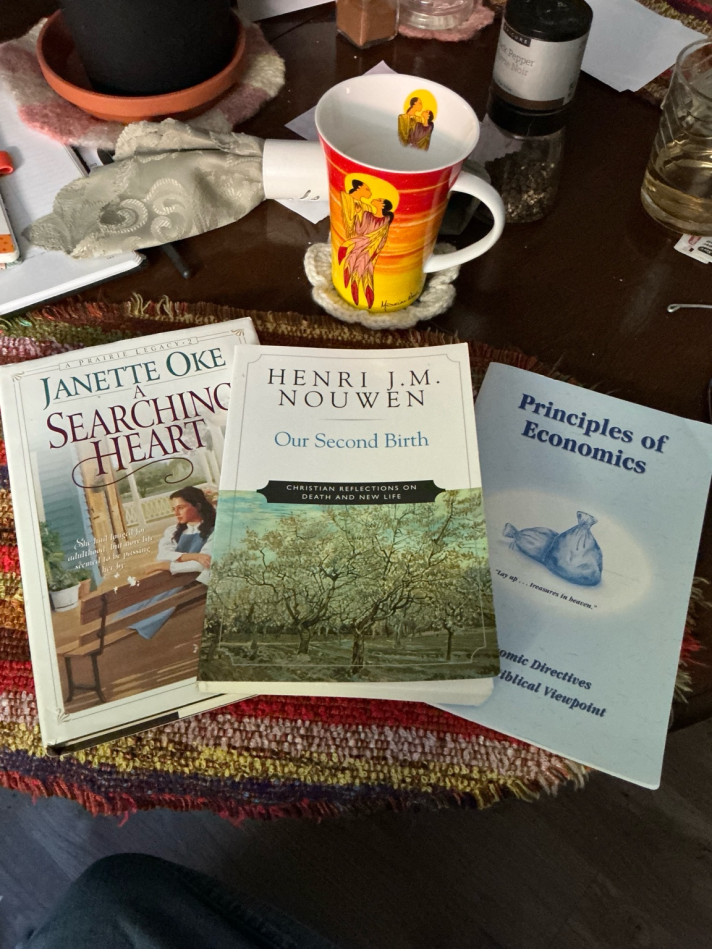
Reading Week Book Selections — A Searching Heart, Our Second Birth, and Principles of Economics
My cozy reading table this week — a balance of study, reflection, and rest.

The first is The Principles of Economics: Economic Directives from a Biblical Viewpoint. It’s helping me think through budgeting and stewardship in a faith-centered way. The second is Our Christian Reflections on Death and New Life by Henri Nouwen. This book draws me deeper into spiritual reflection. It also encourages renewal. And finally, I’ve chosen A Searching Heart by Janet Oke. This novel offers the comfort of a familiar Christian voice. It also gives the simple joy of story.

In this trio, I’ve found a balance: one for the mind, one for the soul, and one for rest.
Economics, theology, and fiction — all working together to nourish different parts of my life.


Learning and Reflection

My goal this week is simple: to learn.
I’ll be reading The Principles of Economics as a Bible study. Each section includes scripture, discussion questions, and reflection prompts. I’m already imagining how this can one day form the basis of a small group study or online discussion series.

The scripture on the opening page reads, “Lay up your treasures in heaven.” That alone sets the tone. Although this book was printed back in 2013 by the Eastern Mennonite Press in Pennsylvania, truth doesn’t age. The principles of faith and finance stay as relevant today as ever.

When I finish, I plan to write a short reflection. I want to capture what I’ve learned. I will also consider how it can shape my ministry.


Theological Growth and Spiritual Nourishment

Henri Nouwen’s Reflections on Death and New Life is where I’ll spend time in theological reflection. I want to see what stands out as I walk through it. I want to understand how it speaks to change, loss, and renewal in my own life. I am also curious about its impact on my ministry.

This isn’t just academic reading. It’s a conversation between faith and life — between God’s promises and my daily realities. It’s also a prompt read as we move toward Advent, a season that holds both waiting and wonder.


Rest, Relaxation, and Renewal

And then there’s A Searching Heart — my “just for me” book.
I don’t always make time for fiction. Still, Janet Oke’s gentle storytelling reminds me to slow down. It encourages me to breathe and rest in the beauty of faith-filled simplicity. Sometimes, we read not to learn, but to be restored.


Why Ministers Need Reading Weeks

In ministry, we’re encouraged to take time each year for continuing education. We have three weeks set apart for growth, learning, and renewal. This reading week is part of that rhythm for me. It’s also a chance to plan ahead. It’s a time to think about Advent themes. It allows me to refill the spiritual well that ministry can so quickly drain.

Not every week of growth has to involve travel or coursework. Sometimes, it looks like a quiet corner and a warm mug. It also includes a stack of books that stretch your heart and mind.

I call that self-ministry. It is a week where you nourish your body and soul. Do this in ways that have been neglected in the busy seasons of service.


Closing Reflection

So, this week I’ll be learning, reflecting, and resting — all at once.
I’ll let these books speak to different parts of my life. I trust that in their pages I’ll find wisdom. I’ll also find challenge and peace.

As you step into your own rhythm this week, it is time to pick up a book. Choose one that speaks to your soul. Whether it’s something practical, something prayerful, or simply a story that brings rest — make space for learning. Allow time for reflection and renewal.

I’d love to hear what you’re reading this season.
Share your favorite faith-filled or comforting book in the comments below. Let’s inspire one another to keep growing in wisdom and grace.

“Lay up for yourselves treasures in heaven…”
Matthew 6:20


With a cozy mug in hand and gratitude in my heart,
— Pastor Barb aka Grannie Doll 🤍
“Creating calm, crafting faith, and cherishing the simple life.”


Living with Thankful Hearts — October 13, 2025

Living with Thankful Hearts

Finding gratitude in God’s design for life – Exodus 20:1–12


Thanksgiving isn’t just a date on the calendar.
It’s a way of living. It is a rhythm of gratitude. This rhythm shapes how we see the world and the One who made it.

Sometimes it feels like life rushes by faster than we can catch our breath. We must pause to remember God’s goodness. When we choose to live by His Word, something quiet and beautiful happens. Our hearts become thankful again.

And God, in His kindness, gives us a guide for living this way. It’s found in the first five commandments. They are not heavy rules. They are invitations to live in gratitude, peace, and love.


🌾 1. Keep God First

“You shall have no other gods before Me.”

A thankful heart begins with remembering who comes first.
When God is at the center, everything else starts to make sense.

It’s easy to let little things — worry, work, or even our own plans — take that place. But gratitude grows when we whisper, “You first, Lord. Everything else can wait.”

That’s where peace begins.


🌿 2. Let Go of Idols

“You shall not make for yourself an idol.”

We may not worship golden statues, but we all have things that try to steal our focus.
Idols today can look like busyness, comfort, approval, or even the endless scroll on our screens.

When we let go of what distracts us, our hands open — and God fills them with His blessings.
Gratitude begins when we see everything as gift, not possession.


💬 3. Speak God’s Name with Love

“You shall not misuse the name of the Lord your God.”

Our words reveal the posture of our hearts.
When we speak with reverence, when we bless instead of complain, we create an atmosphere where gratitude can breathe.

This week, let your words carry kindness. Use a soft tone and say a gentle “thank You, Lord.” Notice how peace follows.


🕊️ 4. Rest in His Goodness

“Remember the Sabbath day and keep it holy.”

Gratitude needs stillness.
When we never slow down, we forget what we already have.

God invites us to pause. Set aside the to-do lists. Pour a cup of tea, take a walk, or rest in His presence.
Sabbath is His reminder that life is more than work; it’s relationship, renewal, and thanksgiving.


🌸 5. Honor Those Who Came Before

“Honor your father and your mother.”

This commandment is about roots — remembering those who loved us into being.
Parents, grandparents, mentors, neighbors — their prayers and faith shape who we are.

To honor them is to carry forward their love, their kindness, and their gratitude for God’s provision.
When we give thanks for them, we pass faith to the next generation.


💛 Living with Thankful Hearts

Gratitude isn’t something we find; it’s something we practice.
When we keep God first, we let go of idols. We speak kindly and rest deeply. By honoring those who came before us, thanksgiving becomes a way of life.

It shows up in our words, our routines, and the way we treat one another.

The commandments aren’t rules to restrain us. They’re the gentle framework that helps us live fully and freely. We live in the presence of a loving God.

So this week, may your table be full. May your rest be sweet. Let your words be gentle. May your heart be centered in the goodness of God.


🌷 A Gentle Prayer

Lord,
Teach me to live with a thankful heart.
Keep You first in all things. Help me rest in Your love. Remind me of those who’ve shown me the way.
Let my words and my days bring You praise.
Amen.


With gratitude and grace,
–Pastor Barb


Share

Living with Thankful Hearts —

Living with Thankful Hearts

Finding gratitude in God’s design for life – Exodus 20:1–12


Thanksgiving isn’t just a date on the calendar.
It’s a way of living. It is a rhythm of gratitude. This rhythm shapes how we see the world and the One who made it.

Sometimes it feels like life rushes by faster than we can catch our breath. We must pause to remember God’s goodness. When we choose to live by His Word, something quiet and beautiful happens. Our hearts become thankful again.

And God, in His kindness, gives us a guide for living this way. It’s found in the first five commandments. They are not heavy rules. They are invitations to live in gratitude, peace, and love.


🌾 1. Keep God First

“You shall have no other gods before Me.”

A thankful heart begins with remembering who comes first.
When God is at the center, everything else starts to make sense.

It’s easy to let little things — worry, work, or even our own plans — take that place. But gratitude grows when we whisper, “You first, Lord. Everything else can wait.”

That’s where peace begins.


🌿 2. Let Go of Idols

“You shall not make for yourself an idol.”

We may not worship golden statues, but we all have things that try to steal our focus.
Idols today can look like busyness, comfort, approval, or even the endless scroll on our screens.

When we let go of what distracts us, our hands open — and God fills them with His blessings.
Gratitude begins when we see everything as gift, not possession.


💬 3. Speak God’s Name with Love

“You shall not misuse the name of the Lord your God.”

Our words reveal the posture of our hearts.
When we speak with reverence, when we bless instead of complain, we create an atmosphere where gratitude can breathe.

This week, let your words carry kindness. Use a soft tone and say a gentle “thank You, Lord.” Notice how peace follows.


🕊️ 4. Rest in His Goodness

“Remember the Sabbath day and keep it holy.”

Gratitude needs stillness.
When we never slow down, we forget what we already have.

God invites us to pause. Set aside the to-do lists. Pour a cup of tea, take a walk, or rest in His presence.
Sabbath is His reminder that life is more than work; it’s relationship, renewal, and thanksgiving.


🌸 5. Honor Those Who Came Before

“Honor your father and your mother.”

This commandment is about roots — remembering those who loved us into being.
Parents, grandparents, mentors, neighbors — their prayers and faith shape who we are.

To honor them is to carry forward their love, their kindness, and their gratitude for God’s provision.
When we give thanks for them, we pass faith to the next generation.


💛 Living with Thankful Hearts

Gratitude isn’t something we find; it’s something we practice.
When we keep God first, we let go of idols. We speak kindly and rest deeply. By honoring those who came before us, thanksgiving becomes a way of life.

It shows up in our words, our routines, and the way we treat one another.

The commandments aren’t rules to restrain us. They’re the gentle framework that helps us live fully and freely. We live in the presence of a loving God.

So this week, may your table be full. May your rest be sweet. Let your words be gentle. May your heart be centered in the goodness of God.


🌷 A Gentle Prayer

Lord,
Teach me to live with a thankful heart.
Keep You first in all things. Help me rest in Your love. Remind me of those who’ve shown me the way.
Let my words and my days bring You praise.
Amen.


With gratitude and grace,
–Pastor Barb


Share

Live Thankfully, Love Locally — October 11, 2025

Live Thankfully, Love Locally


Discover how gratitude and faith can reshape your daily choices. This Thanksgiving, learn to live thankfully and love locally — nurturing community, faith, and simplicity within your 100-mile circle.


By Grannie Doll | DollCanCreate

The air turns crisp. The scent of cinnamon drifts from the kitchen. I’m reminded that gratitude is more than a feeling. It’s a way of life.
This Thanksgiving, I’m learning that to live thankfully means noticing the simple gifts around me. To love locally is to cherish the hands and hearts that make them possible.

🍎 Thankfulness in the Everyday

Gratitude doesn’t always arrive wrapped in grand moments.
The morning light on a freshly baked loaf of bread can bring gratitude. The soft hum of a spinning wheel or the laughter shared over a home-cooked meal can also evoke this feeling.
When we live thankfully, we slow down long enough to see how much we’ve already been given. The small becomes sacred.

“Give thanks to the Lord, for He is good; His love endures forever.”
— Psalm 107:1

🧵 Loving Locally

Loving locally means embracing what’s near. It includes buying from the farm stand down the road. You might choose wool from a shepherd you know by name. It could also mean supporting the little shop that remembers your favorite tea.
It’s about more than economics—it’s about belonging. Every local choice becomes a prayer of connection, a way of saying, “I see you. I value you. We’re in this together.”

When we love locally, we weave ourselves into the fabric of community. We become part of God’s quiet work of restoration—one handmade loaf, one kind word, one shared harvest at a time.

🕯 A Faithful Thanksgiving

This season, let’s make gratitude our posture and generosity our practice.
Let’s cook with local ingredients and bless the farmers who grew them. Let’s give thanks for wool, for warmth, for the steady rhythm of creation that provides what we need.
Let’s live thankfully—and love locally—because both are acts of faith.

“And whatever you do, whether in word or deed, do it all in the name of the Lord Jesus, giving thanks to God the Father through Him.”
— Colossians 3:17

🌻 A GrannieCore Reflection

To live thankfully is to dwell in grace.
To love locally is to live it out.
Together they form a rhythm—slow, simple, sacred—that brings us back home to God’s abundance.


Reflection
What’s one way you can love locally this week—through your shopping, your crafting, or your kindness?


With wool, warmth, and gratitude,
💛 Grannie Doll


God Provides: Finding Daily Bread in the Wilderness — October 5, 2025

God Provides: Finding Daily Bread in the Wilderness

Have you ever had one of those days when the worries of tomorrow press in so hard? It can be difficult to see the blessings of today. Bills stack up, cupboards look bare, and your heart begins to grumble. You’re not alone—God’s people in Exodus 16 felt the same way.

The Israelites had just experienced the miracle of crossing the Red Sea. They found themselves wandering in the wilderness with empty stomachs. Their hearts were fearful. They complained, longing for the food they remembered in Egypt. Isn’t it striking how quickly we forget God’s faithfulness when we are uncomfortable?

And yet, God answered not with anger, but with mercy. Each morning, bread from heaven—manna—appeared on the ground, and in the evening quail filled their camp. Enough for the day. Not enough to hoard, but enough to teach them to trust.


Lessons in God’s Daily Provision

1. Complaining clouds gratitude.
Israel looked backward instead of upward. When we complain, we miss the evidence of God’s hand right in front of us.

2. God provides for today.
The manna was daily bread. Just as His mercies are new every morning, His provision comes in daily trust.

3. His gifts are sufficient.
No one gathered too much or too little. Each had exactly what was needed. That truth still holds: God’s grace fits your life perfectly.


From Manna to Christ

Centuries later, Jesus declared, “I am the Bread of Life” (John 6:35). The manna in the wilderness was just a glimpse of the greater gift—Christ Himself, who sustains us in every season. When we feel empty, He fills. When tomorrow looks uncertain, He reminds us He is already there.


A Thought to Carry

Today, pause and notice the manna God has placed before you—the mercies you might have overlooked. Breathe in gratitude. Trust that tomorrow’s bread will come, because the same God who fed Israel feeds your soul.

“The steadfast love of the Lord never ceases; his mercies never come to an end; they are new every morning; great is your faithfulness.” — Lamentations 3:22–23


Let’s Share Together
Have you noticed “manna moments” in your life lately? These are little daily provisions. They remind you that God is near. I’d love to hear from you in the comments. If this reflection spoke to your heart, please consider subscribing. This way, we can walk this journey of faith together week by week.

Here I Am, Send Me — September 29, 2025

Here I Am, Send Me

Exodus 3:1–15 & John 8:56–58

Moses was going about an ordinary day. He was tending sheep in the wilderness. Then God showed up in the extraordinary. It was a bush aflame but not consumed. Out of that fire came a voice: “Moses, Moses!” And Moses replied, “Here I am.”

This story reminds us that God often meets us in the middle of our daily lives. It may not be through a burning bush. It can happen in a quiet walk, a conversation, or a moment of stillness. These are the moments when we suddenly sense His presence. Ordinary places become holy ground when God is there.

When God called Moses, Moses hesitated: “Who am I that I should go?” And God’s answer was not to build Moses’ confidence but to assure him: “I will be with you.” That same promise continues in the words of Jesus. He said: “I am with you always, even to the end of the age” (Matthew 28:20).

At the burning bush, God revealed His name: “I AM WHO I AM.” Centuries later, Jesus would echo those words: “Before Abraham was, I AM” (John 8:58). The same God who called Moses calls us still. He is revealed fully in Christ. Christ walks with us, strengthens us, and sends us.

So when God calls your name, you have opportunities to show kindness. You can forgive. You can serve. You can also take a step of faith. You don’t need to ask, “Who am I?” Instead, trust in who God is. The great I AM goes with you.

Reflection Question

Where is God calling you to turn aside and notice God’s presence this week?

Prayer

Lord Jesus, You are the great I AM. Thank You for calling us by name. Thank You for sending us in love. Thank You for walking with us each step of the way. Help us to answer with courage: “Here I am, Lord. Send me.” Amen.

🍂 Rocking Chair Reflections: What September Taught Me — September 27, 2025

🍂 Rocking Chair Reflections: What September Taught Me

Pull up a chair, pour yourself a cup of tea, and settle in with me. The needles are clicking softly in my hands. I think back over September. It has taught me more than I expected. The evenings are drawing in. The air has turned crisp. I find myself reflecting on what both DollCanCreate and this gentle GrandmaCore life have whispered into my days.


🌿 What DollCanCreate Reminded Me

  • Showing up matters. Some days, all I had to share was a sock half-knit. Occasionally, it was a quick glimpse of tomatoes from the farm store. But I learned again that it’s the rhythm of showing up, not the perfection of the finish, that connects us.
  • Local stories hold power. A skein of wool from down the road carries more than just flavor and texture. Apples from the orchard do as well. They carry a story. September proved that when I share those stories, others feel rooted too.
  • Different doors, same home. People came in through different channels, whether it was a blog post, a YouTube vlog, or a printable checklist. However, they all entered the same cozy home. That felt like a gift.

🧶 What GrandmaCore Whispered

  • Slow is a rebellion. Sitting in a rocking chair while the world rushes by isn’t laziness — it’s choosing presence. Each stitch is a small “no” to the frenzy and a gentle “yes” to peace.
  • Hospitality is holy. A warm welcome doesn’t always look like a grand dinner. Sometimes it’s sharing a cinnamon bun from the farm store, or simply offering listening ears and soft yarn to touch.
  • Faith knits it all together. The scriptures I carried this month reminded me of new mercies every morning. They spoke of scars healed in Christ and blessings of the harvest. This reminds me that GrandmaCore isn’t just about cozy living. It’s about rooted, faithful living.

✨ A Lesson for the Heart

If September had one message, it was this:
ordinary life is sacred. Slow living is not wasted living.

Every sock stitch, every apple pie, every whispered prayer is part of the greater pattern God is weaving. And sometimes the rocking chair is the holiest place of all.


📖 Scripture to Rock With

“The steadfast love of the Lord never ceases; his mercies never come to an end; they are new every morning; great is your faithfulness.”
— Lamentations 3:22–23


🌸 A Cozy Blessing

As you step into October, may you carry September’s gentle lessons with you.
May you find warmth in small joys. Find rest in quiet moments. Trust in God’s faithfulness — stitch by stitch, day by day.

From my rocking chair to yours,
Grannie Doll 🧶💜


Wounded, Yet Blessed — September 21, 2025

Wounded, Yet Blessed

Genesis 32:9–30

Have you ever carried a wound so deep it shaped how you walk through life? Maybe it’s the ache of grief, the weight of regret, or the slow wear of illness. Jacob knew what that was like. One dark night, on the banks of the Jabbok River, he wrestled with God and walked away limping. But he also walked away blessed.

Jacob’s story is strange and mysterious, but it’s also deeply human. Because we all wrestle. We wrestle with our past, our doubts, our fears, our relationships—and sometimes with God Himself. And like Jacob, we don’t come out of those nights unmarked.


Wrestling in the Dark

Jacob’s prayer that night is raw and honest: “I am unworthy… deliver me, I pray” (vv. 10–11). That’s where wrestling begins—with honesty. We don’t need fancy words to get God’s attention. We can bring our fear, our need, our brokenness just as it is.

In the darkness, Jacob wrestled until dawn. It wasn’t a clean, easy fight. It was gritty. It was exhausting. And that’s how faith often feels. But wrestling is not weakness. Wrestling is faith refusing to let go.


The Limp and the Blessing

At the turning point, God touches Jacob’s hip, leaving him wounded. From then on, Jacob walks with a limp. But the limp isn’t a curse. It’s a sign. Jacob has met God face to face and survived. He has a new name—Israel, the one who struggles with God.

We, too, carry limps:

  • The limp of grief after loss.
  • The limp of chronic pain or illness.
  • The limp of regret for words we can’t take back.
  • The limp of a heart broken by disappointment.

Our woundedness is real. It changes how we move through life. But here’s the hope: our wounds can also be the places where God meets us. They are the places where He blesses us and makes us new.


From Jacob to Jesus

Jacob’s limp points us towards, to another who would be wounded: Jesus Christ.

  • Jacob wrestled in the dark; Jesus wrestled in Gethsemane, sweating drops of blood.
  • Jacob was struck in the hip; Jesus was pierced in His hands, His feet, and His side.
  • Jacob limped into the sunrise. Jesus carried His wounds to the cross. Three days later, He rose into the dawn of resurrection.

And here’s the miracle: by His wounds, we are healed (Isaiah 53:5). The risen Christ still bore His scars—they were not erased but glorified. And so too, our wounds can become testimonies of grace.


Wounded, Yet Blessed

Jacob clung to God and said, “I will not let you go until you bless me.” That’s faith: holding on in the dark, even when wounded, until the blessing comes.

Friends, whatever limp you carry today, don’t let go. Bring your wounds to Jesus, the wounded healer. Cling to Him. Because in Him, even our deepest wounds can become the doorway to blessing.


Reflection Question

What wound do you carry that God want to turn into a place of blessing?


Prayer

Lord Jesus, you are the wounded healer. We bring you our limps, our scars, our hidden hurts. Bless us in our struggles. Teach us to see our wounds not as shame but as signs of your grace. By your wounds we are healed. Amen.


👉 If this reflection speaks to you, share it with someone who may be wrestling in their own dark night. You never know what blessing your encouragement might bring.

When God Makes Us Laugh — September 14, 2025

When God Makes Us Laugh

Have you ever laughed at something that seemed impossible? Maybe you’ve laughed when someone told you a story you couldn’t quite believe. Or maybe you laughed in disbelief at a surprise — a phone call, a healing, a blessing you never expected. Sometimes our laughter comes from joy, but sometimes it comes from the thought, “That could never happen.”

That was Sarah’s laugh. She overheard God’s promise that she would have a son in her old age, and she laughed. It seemed too late. Too impossible. Too far gone. And yet, God kept His promise.


God Shows Up in the Ordinary

Abraham and Sarah weren’t in a temple or on a mountaintop when the promise came. They were sitting in their tent on an ordinary day. Three strangers arrived, and Abraham offered hospitality — water, bread, shade. It was through that everyday kindness that God’s promise was revealed.

God often comes to us not in grand gestures. Instead, we find Him in ordinary moments. These moments include a phone call from a friend, a kind word from a neighbor, or a shared meal.


God’s Timing Isn’t Our Timing

By the time of this story, Abraham and Sarah had been waiting for years. The promise of a child had been given, but no child had come. Hope felt gone. So when the message finally came, Sarah laughed.

We understand that, don’t we? Waiting is hard. Whether we are waiting for healing, for answers, or for peace, it can feel like God is late. But the truth is: God is never late. God’s timing not match ours, but it is always right.


God Turns Doubt into Joy

Sarah’s first laugh was a laugh of disbelief. But when her son Isaac was born, her laughter was filled with joy. “God has brought laughter for me; everyone who hears will laugh with me,” she said.

God is in the business of transforming. He turns sorrow into joy, tears into laughter, impossibility into blessing. He turns our doubts into testimonies of His faithfulness.


What About Us?

The question asked in Genesis still speaks to us today: “Is anything too wonderful for the Lord?”

The answer is no. Nothing is too wonderful. Nothing is too hard. Nothing is impossible with God.

And maybe, just maybe, God will bring us laughter, too.


🌿 This week,

pay attention to the ordinary moments of your life — a conversation, a visit, a quiet walk. Ask yourself: Where might God be showing up today?

And if you are waiting on God for something, take courage. Sarah’s laughter reminds us that God keeps His promises.

💬 I’d love to hear from you:

  • Where has God surprised you with joy in an unexpected place?
  • Has there been a time when God turned your doubt into laughter?

Share your story in the comments — your laughter might just encourage someone else’s faith today.