
Welcome back, dear friends. It’s Grannie Doll here. I’m settling in with a cup of something warm. I’m living my 100-Mile Life one peaceful, wool-filled moment at a time.
This week, as part of Spindlemas, I found myself drawn back to a question many beginning spinners ask:
“How many kinds of spindles are out there—and how many does a spinner really need?”
Well… pull up a chair. Today I’m opening up my own spindle basket. I will share stories from the past twenty-one years of spinning joy. I will talk about learning curves and the quiet magic of handmade tools.
My First Spindle: Where It All Began
Every maker has that one tool that started it all.
Mine is a sturdy little drop spindle from 2004. It is hand-painted and well-loved. The paint is now gently wearing away after decades of use.
When I hold it, I remember those early days—fumbling fingers, lumpy yarn, and that unmistakable spark of Oh! I can make this myself.
That spark has carried me a long way.
Black Spruce and Alaskan Memories
Not long after, my husband Nick carved me a lightweight spindle from Black Spruce in Fairbanks, Alaska.
The bark has thinned over time, the wood mellowed, but it still spins fast and true. I can almost hear the quiet of the Alaskan woods every time the whirl turns.
These tools hold memories as much as they hold wool.
Spindle Exchange Surprises
Some treasures arrive by mail.
Years ago, during a spindle exchange, I received a sweet little hand-painted spindle. It was light as air. It was clearly fashioned from a drawer pull. Creative, whimsical, and full of charm.
Another exchange brought me a brightly colored whorl. It still spins beautifully. It is a little chipped from life, but so am I. Aren’t we all?
And yes… tucked among the collection is a tahkli spindle. It has a metal shaft and bead whorl. It is gorgeous and mysterious. It still whispers, “You’ll learn me someday.”
One day, little spindle. One day.
The Spindles I Reach for Most
Like many spinners, I have favourites that become old friends.
My Ashford Pair
- A tiny light Ashford that spins like a dragonfly’s wing.
- A larger Ashford that once met the wrong end of a dog’s teeth. A little tape, a lot of forgiveness, and she still spins beautifully.
My Beloved Unknown-Maker Spindle
Purchased somewhere near Owen Sound, this dark wooden beauty is my go-to for plying. The tip is finely crafted, the spin steady and long. She feels like poetry in the hand.
The Celtic Spindle
3D-printed, light, with a triskele design that feels rooted in ancient story. It spins like a dream—modern meets myth.
Moose-Mark Spindles
A pair from the Almonte Fiber Festival, each with a tiny moose on the underside. They’re balanced, strong, and perfect for plying.
My New Support Spindle
A recent adventure.
Metal tip, beautifully made, still leaving me humble and hopeful.
Support spindle spinning is on my “learn this well” list for 2026.
And then… the Turkish Treasure
This one is pure joy.
Made by Helen—whose motto is “Sawdust is my glitter.”
Smooth, elegant, satisfying in the hands, and spinning as gracefully as a leaf falling through still air.
What I Spin With These Tools
A spindle is only half the story.
The fiber tells the rest.
Right now in my basket:
- A golden BFL dyed with Wilton’s food coloring
- A soft pink Merino blend from last Distaff Day
- A deep botanical-dyed BFL (onion skins + avocado = magic)
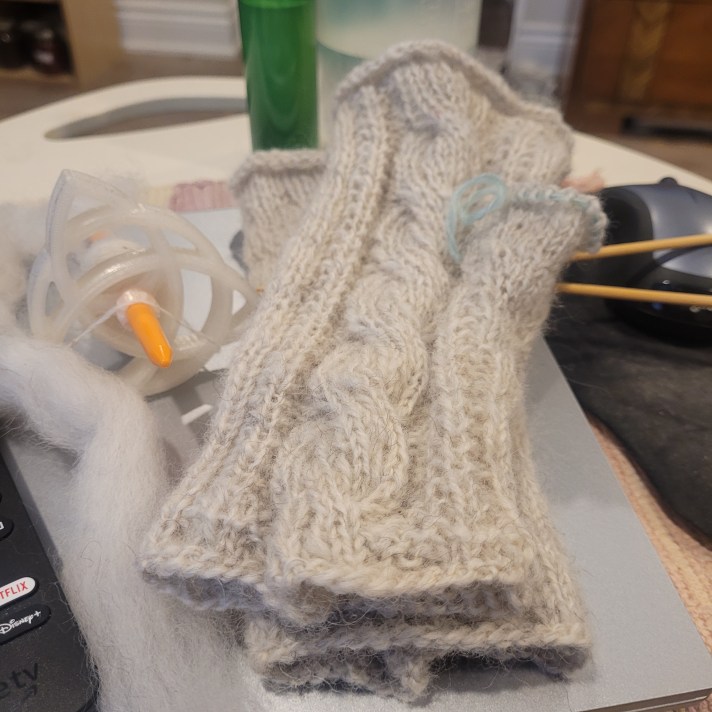
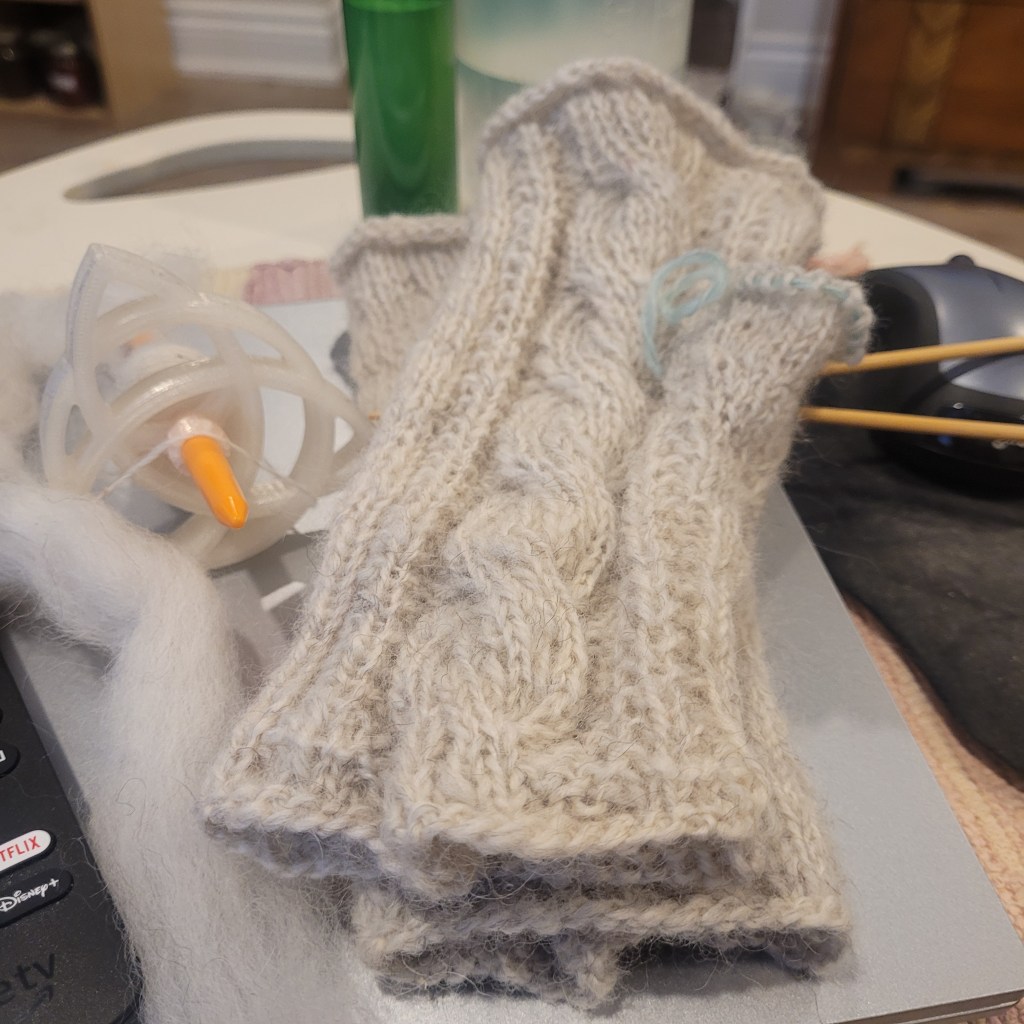
- My Shetland mittens—white for one pair, and a beautifully varied Shropshire fiber for another
- A cheerful pink hand-dyed skein working its way into a Heel Toe Do-Si-Do sock
And yes, sometimes my colors clash with my shirt. That’s part of the charm.
Where Wheel and Spindle Meet
You already know I spin my sweater yarn on the wheel. But what about the mittens, scarves, hats, and the bits that feel more intimate and slow? Those come from the spindle.
There’s something grounding about holding a tool that fits in the palm of your hand. You feel the twist travel through your fingers. You realize you are the engine.
Slow, steady, soulful.
A Peek Behind the Scenes
If you’ve watched my Spindlemas videos, you’ve probably seen:
- The lavender vase beside my spindles
- The Folgers tub blocking the cat from pressing random printer buttons
- My plastic bowl full of tools—scissors, needles, bits and bobs every crafter keeps nearby
This is real life, Grannie-Core at its finest: cozy, functional, imperfect, and full of love.
A Question for You
What is your favourite sheep breed to spin or knit with?
Mine, so far, is Shetland—lofty, springy, forgiving, and perfect for the slow-living rhythm I crave.
Tell me yours in the comments so we can start a lively woolly conversation.
A Closing Thought for Advent
Whether you’re celebrating Christmas, lighting Advent candles, or simply leaning into the hush of winter…
Let’s prepare our hearts for a world that is gentler, kinder, more hopeful.
Handwork teaches us that small things—twists of fiber, quiet moments, patient stitches—add up to something much bigger than we imagined.
From my home to yours,
this is Grannie Doll living the 100-Mile Life.
Like, subscribe, share if this warmed your heart—and remember:
If DollCanCreate… maybe you can too.
God bless, dear friends. ♥
