What if everything you ate, wore, and used came from within 100 miles of your home? No big-box stores, no global supply chains—just what’s near, what’s seasonal, and what’s truly local.
That’s the challenge I’ve taken on for 100 days: living as locally as possible. This isn’t just about food (though that’s a big part of it). It’s about fiber, household goods, and the relationships that sustain a truly local life.
What I’ve learned so far is that living locally isn’t about finding a perfect replacement for everything—it’s about rethinking what I actually need. It’s about discovering abundance in my own backyard.
Here are some of the ways I’m embracing this lifestyle, and practical steps you can take to live more locally, too.
Food & Cooking: Eating with the Seasons
Food is one of the biggest shifts when committing to a 100-mile life. We’re so used to having whatever we want, whenever we want it, that we forget food has a season.
Buy from Local Farmers – Farmers’ markets, CSAs (community-supported agriculture), and direct farm sales have become my go-to. Not only does the food taste better, but I’m also building relationships with the people who grow it.
Cook Seasonally – Instead of planning meals and shopping for specific ingredients, I’m flipping the approach—I buy what’s local and in season, then create meals around it.
Preserve the Harvest – I’m learning to can, freeze, and ferment so I can eat locally even in the off-season. (My first attempt at pickled beets was… interesting. But I’ll get better!)
Grow My Own – Even a small herb garden or a few raised beds can add fresh, local flavor to meals.
Trade & Barter – A neighbor has fresh eggs, another bakes sourdough bread. By swapping what we have, we all get a little more variety while staying local.
Clothing & Textiles: From Fleece to Fabric
Sourcing clothing locally is a challenge, but it’s one I’m excited about—especially since I love fiber arts.
Support Local Fiber Farms – I’ve been connecting with nearby sheep and alpaca farms to source fiber for my knitting and spinning projects. There’s something special about working with wool from animals raised close to home.
Make & Mend – Instead of buying new, I’m knitting my own socks and sweaters. And if something tears, I repair it instead of tossing it.
Experiment with Natural Dyeing – I’m trying out plant-based dyes from local sources like onion skins, acorns, and flowers. (I’ll report back on my results—expect some trial and error!)
Seek Out Local Makers – Weavers, seamstresses, and artisans are out there—you just have to look. Finding someone who crafts clothing locally is a rare but valuable connection.
Home & Living: Bringing It All Closer to Home
Beyond food and fiber, I’m also thinking about the everyday things I use at home.
Use Local Wood – Whether for furniture, crafts, or even firewood, sourcing wood locally is a more sustainable choice.
Find Local Artisans – Handmade pottery, candles, soap, and cleaning products can often be found close to home, supporting small businesses instead of big corporations.
Reduce Waste – Living locally isn’t just about buying local—it’s also about making things last. I’m focusing on repairing, repurposing, and reusing instead of replacing.
Community & Connection: The Heart of a Local Life
One of the most unexpected joys of this challenge has been the relationships I’m building. Living locally isn’t just about what I consume—it’s about the people I connect with.
Build Relationships with Local Producers – Knowing the farmers, spinners, and craftspeople in my area makes this journey feel richer and more meaningful.
Join a Local Exchange – Trading homemade or homegrown goods with others makes local living more sustainable and fun.
Learn Traditional Skills – Bread baking, cheese making, beekeeping—these skills are disappearing, but they make a huge difference in living a truly local life.
Support Local Businesses – Every dollar spent at a small, locally owned business strengthens the community.
Final Thoughts
This journey isn’t about perfection—it’s about intention. It’s about slowing down, paying attention, and living in rhythm with where I am.
I’d love to hear from you! What’s one way you could start living more locally? Let’s share ideas and encourage each other on this journey.
I’ll be sharing more updates, challenges, and lessons learned along the way—so stay tuned! 💛
As we journey through Lent, we are invited to draw closer to God through reflection, repentance, and renewal. The Psalms serve as a rich source of encouragement, reminding us of God’s presence in every season of life—whether we are seeking His protection, thirsting for His presence, or crying out for His mercy.
In this week’s readings (Days 15–22), we will walk through psalms that highlight themes of trust, forgiveness, longing, and divine shelter. These passages offer a place of refuge in times of struggle and a song of praise in moments of renewal. Each day provides an opportunity to meditate on God’s faithfulness and to respond with prayer, inviting Him to work in our hearts during this sacred season.
As you engage with these psalms, consider how they resonate with your Lenten journey. What fears or burdens do you need to surrender? How is God calling you to deeper trust? May these readings strengthen your faith and remind you that He is your light, your portion, and your ever-present help.
Let me know if these readings bless you in any way.
Blessings,
Pastor Barb
Day 15: Psalm 27 – Confidence in God’s Protection
📖 Reading: Psalm 27:1-5 🙏 Reflection: The Lord is our light and salvation; whom shall we fear? This psalm reminds us that God is our refuge and strength. 🧶 Prayer Prompt: Reflect on a time when God has been your stronghold. Ask for renewed trust in His protection.
Day 16: Psalm 32 – The Joy of Forgiveness
📖 Reading: Psalm 32:1-7 🙏 Reflection: This psalm celebrates the blessing of being forgiven. Confession brings freedom, and God’s mercy covers all sin. 🧶 Prayer Prompt: Spend time in confession and thanksgiving for God’s unfailing forgiveness.
Day 17: Psalm 42 – Thirsting for God
📖 Reading: Psalm 42:1-5 🙏 Reflection: “As the deer pants for streams of water, so my soul pants for You.” In times of dryness, God remains our living water. 🧶 Prayer Prompt: Ask God to deepen your hunger for Him and to satisfy your spiritual thirst.
Day 18: Psalm 51 – A Clean Heart
📖 Reading: Psalm 51:10-17 🙏 Reflection: David’s cry for mercy is a model for repentance. God delights in a broken and contrite heart. 🧶 Prayer Prompt: Pray for a renewed heart and spirit, asking God to restore your joy.
Day 19: Psalm 63 – Seeking God First
📖 Reading: Psalm 63:1-8 🙏 Reflection: David longs for God in a dry and weary land. True satisfaction comes only from seeking Him. 🧶 Prayer Prompt: Dedicate your day to seeking God first in all you do.
Day 20: Psalm 73 – God is My Portion
📖 Reading: Psalm 73:21-26 🙏 Reflection: When our hearts fail, God remains our strength and portion forever. 🧶 Prayer Prompt: Meditate on what it means for God to be your portion and your inheritance.
Day 21: Psalm 91 – Resting in God’s Shadow
📖 Reading: Psalm 91:1-4 🙏 Reflection: Those who dwell in God’s presence will find rest and protection under His wings. 🧶 Prayer Prompt: Pray for peace and security in the shelter of the Almighty.
Day 22: Psalm 121 – My Help Comes from the Lord
📖 Reading: Psalm 121:1-8 🙏 Reflection: The Lord watches over you and will not let your foot slip. He is your keeper. 🧶 Prayer Prompt: Lift up your concerns and trust God to be your help and keeper.
Welcome! If you’re new to spinning, this post is for you. I’ll be sharing five essential items that will help you get started. Spinning is an ancient craft, one that predates the spinning wheel itself. Before the wheel, people used a simple yet effective tool: the spindle. Let’s dive into what you need to begin your own spinning journey.
1. A Spindle
When I first started spinning, I was looking for an affordable way to make 100% wool socks. The yarn available in my area was mostly plain white or brown, so someone suggested that I try spinning my own. That’s when I discovered the drop spindle.
I bought my first spindle on eBay, and it came with some fiber to practice on. Over time, I’ve gathered several different spindles, each with unique characteristics:
DIY Spindles: My husband made one using a dowel, a round piece of wood, and a cup hook.
Plastic Spindles: I have a small 3D-printed spindle that’s lightweight and easy to use.
Top and Bottom Whorl Spindles: Both work well; it’s all about personal preference.
Turkish Spindles: These allow you to create a center-pull ball as you spin.
Heavier Spindles: Ideal for plying and getting a leader started.
The key is finding a spindle that spins smoothly and suits your style.
2. Fiber and Fiber Preparation Tools
Once you have a spindle, you’ll need fiber! You can buy pre-washed and prepared fiber or process raw fleece yourself. If you’re preparing fiber at home, you’ll need tools to help:
Dog Brushes: Before I bought hand cards, I used two dog brushes to prepare fiber.
Hand Cards and Drum Carders: These tools help align fibers for easier spinning.
Combs: Useful for finer fiber preparation.
Spinning starts with good fiber prep, so having the right tools can make a big difference.
3. A Niddy Noddy
A niddy noddy is a tool that helps measure and skein your yarn. I have a handmade wooden niddy noddy that my husband crafted in 2004. I also have a 3D-printed version that is more compact and versatile.
By wrapping yarn around the niddy noddy, I can measure my yardage and prepare the yarn for setting. Whether you choose wood or plastic, this tool is incredibly helpful for any spinner.
4. Wraps Per Inch (WPI) Tool
A WPI tool helps determine the thickness of your yarn by counting how many times it wraps around a set measurement. If you don’t have a WPI gauge, a standard ruler works just as well!
Knowing your WPI helps ensure that your handspun yarn is the right weight for your project, whether you’re making socks, shawls, or sweaters.
5. A Lazy Kate or Alternative Plying Solution
If you plan to ply your yarn, a lazy kate can be very useful. While some wheels have built-in lazy kates, I’ve also used DIY solutions:
Handmade Lazy Kate: My husband made one using a log and dowels.
Plying Bracelet: When working with a single ply, I sometimes wrap it around my wrist and ply from there.
A lazy kate or an alternative plying method helps keep tension even and makes plying much easier.
Bonus: The Joy of Slow Spinning
Spinning is more than just making yarn—it’s a meditative and mindful process. Whether I’m in my rocking chair spinning, or walking outside with a spindle in hand, I find that this craft allows me to slow down and be present. Sometimes, I even use my spinning time for prayer and reflection.
There’s something deeply satisfying about creating yarn from fiber, knowing that each step of the process is part of a long-standing tradition. So if you’re just starting out, take your time, enjoy the process, and embrace the rhythm of spinning.
If you’d like to see a spindle demonstration, let me know! And don’t forget to subscribe, comment, and share your spinning journey. May you find blessings in each day. Happy spinning!
As I sat down to prepare my sermon, I found myself drawn to the concept of small beginnings—tiny sparks of faith that grow into something significant. This theme, often expressed through the parables spoken by Jesus, beckons us to look closer. Parables, after all, provide stories with hidden meanings, and if we’re not attentive, those messages might pass us by. The disciples notably missed the point on occasion, requiring Jesus to retell the stories, much like the one we heard today.
One parable speaks of yeast, small and seemingly insignificant, hidden within a large quantity of flour. Yet, it causes the entire batch to rise. The hidden yeast is much like the mysterious presence of Jesus Christ within us—a small, potent force that propels growth. Sometimes, we might question, is God really with us? Can He hear us? In those moments of doubt, we’re reminded that a tiny spark of the divine rests on our shoulders, urging us to keep these truths in our hearts.
Our spiritual journey is likened to a mustard seed or a grain of salt that infuses and transforms. Each of us conceives Jesus differently—perhaps as the Good Shepherd, the light of the world, or the bread of life. Regardless of perspective, the essence remains the same: He is the alpha, omega, and the Wonderful Counselor.
The disciples pondered the kingdom of God—curious if it mapped out like earthly borders. Parables, though, challenge such delineation. Imagine placing the Messiah in a box! The kingdom of God defies such constraints; it’s like a mustard seed or hidden yeast. It is a part of all of us, growing endlessly.
We’re attending worship today, and during this Lenten season, fulfilling our spiritual obligations is important. But here’s the catch: the seed of Christ in us can’t remain dormant. Just as we evolve through life’s stages, the divine spark within us must grow. Our growth is not only physical but spiritual, too. Worship, scripture readings, and hymns nourish this growth. They compel us to dust off our Bibles or explore new versions, nurturing the faith seeded in our hearts.
I recall a beloved story: a child grows into a man, much like our faith evolving from simple beginnings. This growth, often slow like sourdough bread rising, requires patience. Similarly, in our spiritual lives, patience, care, and love are necessary for fostering that divine spark. Like bread, as we rise in faith, we must be patient with ourselves, allowing room for grace and growth.
Jesus’ teachings about the kingdom of God being life-giving remind us of the simple blessings—like a stranger’s smile or a helping hand. These small gestures build us up, compelling us to continue their spread.
Do we recognize that divine leaven within us? Jesus Christ resides in our hearts daily, but do we feed that leaven and witness God’s love expanding within us? We often see growth in others, yet it is difficult to find it in ourselves due to self-critique. Still, self-examination can pave the way for improvement, encouraging us to embrace our spiritual journey.
An amusing anecdote highlights my blunders and the ongoing cycle of giving. Let’s just say, amidst donations, my bathing suit inadvertently got shifted to charity. Moments like these spark laughter and serve as gentle reminders of life’s lighthearted aspects even as we endeavor to bless others with our offerings.
In conclusion, though seemingly small in life’s grand design, each of us carries God’s kingdom within. Whether as a seed or yeast, it grows only when nurtured with love and grace. Our divine spark, when nourished, transforms us into who God intends us to be. Amen.
Join me as we sing “In the Bulb There is a Flower” and reflect upon these small, transformative blessings. Let us pray and offer gratitude for the bounty of life and lend support through music and prayer, trusting in God’s grace to guide us.
As we prepare for the world outside, let us allow our faith and hope to rise, much like the yeast in bread. May we carry this message out, in the name of God, our Creator, Jesus, our Brother, and the Holy Spirit who lifts us. Let’s hold onto these truths, examining how God’s kingdom prompts inner transformation, nourishing us to be channels of love and grace in the world.
I hope this sermon and reflection inspire your spiritual growth and journey during this Lenten season and beyond.
We continue through Lent to ponder and pray. We’re crafting each day on a project that brings us closer to God. Read the passage 3 times, sit for a while to see what comes up for you. Craft and pray.
Week 2: Signs and Miracles
Day 8: John 5:1-9 Reflection: Jesus heals the man at the pool. What healing do you need from Him? Prayer: Lord, speak healing over my body, mind, and spirit. Amen.
Day 9: John 6:1-14 Reflection: Jesus feeds the five thousand. Do you trust Him to provide for your needs? Prayer: Provider God, I trust You to meet all my needs. Amen.
Day 10: John 6:35-40 Reflection: Jesus is the Bread of Life. Are you nourishing yourself with His Word? Prayer: Lord, sustain me with Your truth each day. Amen.
Day 11: John 7:37-39 Reflection: Jesus promises the Holy Spirit as living water. Are you open to His presence? Prayer: Holy Spirit, flow through me and refresh my soul. Amen.
Day 12: John 8:12 Reflection: Jesus is the Light of the World. Are you walking in His light? Prayer: Lord, lead me out of darkness and into Your marvelous light. Amen.
Day 13: John 9:1-7 Reflection: Jesus heals a blind man, revealing God’s power. Where do you need spiritual sight? Prayer: Open my eyes, Lord, to see Your truth. Amen.
Day 14: John 10:11-18 Reflection: Jesus is the Good Shepherd. Are you listening to His voice? Prayer: Shepherd me, Lord, and keep me close to You. Amen.
Have you ever wondered what I do when I’m not sitting in the rocking chair? Stay tuned! Sometimes I’m in the furnace room, carding wool. Other times, I’m at the spinning wheel, spinning wool. I spend time at the kitchen table doing my journals, and sometimes, I just settle in with a good book.
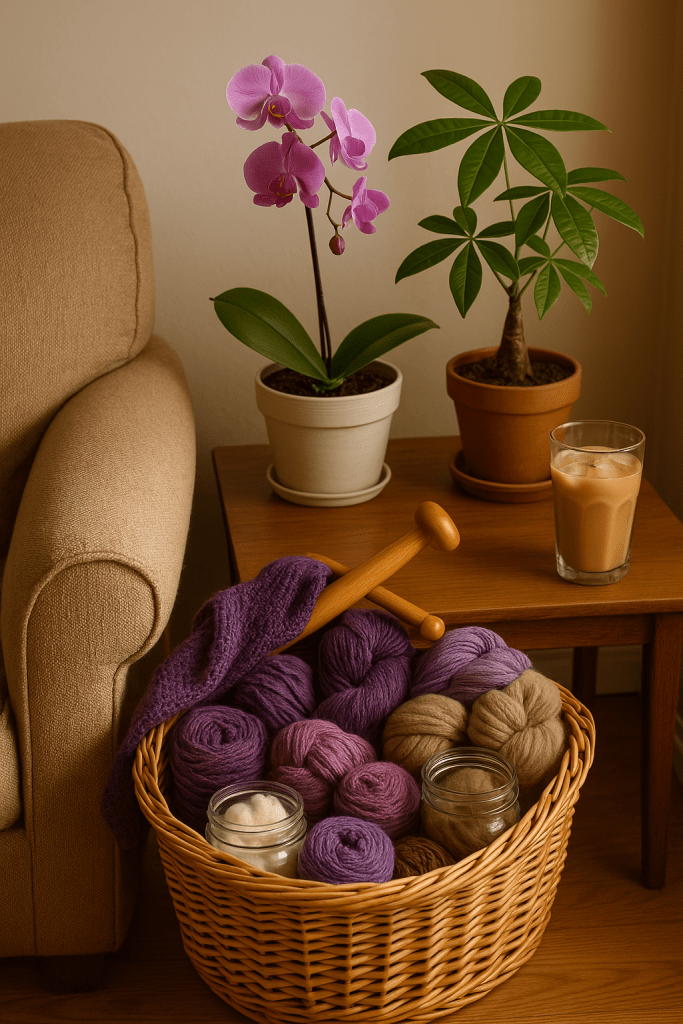
Hi friends! This is Doll from DollCanCreate, and I’m so glad you popped in today while we have our rocking chair knit and chat. I normally do this at the end of the week, but life got busy, and I fell a couple of days behind. But I know you understand that all too well! So here I am, rocking away with my beautiful purple prayer shawl—a special gift from 2013 that still brings me comfort, especially now, during Lent.
Grab your favorite beverage! Mine is almost gone, and yes, it’s coffee—of course, of course! I’m sipping it from my beautiful cup featuring Maxine Noel’s Indigenous woman design. Let’s chat about my 100 Mile Life adventure, what’s working, what’s not, and where we’re at now. It’s so easy to forget and pick up something from the store that doesn’t quite fit the 100-mile radius goal. That’s part of what we’ll talk about, along with my works in progress, some spinning, and spindling.
Lenten Knitting and Works in Progress
We are in Lent—day five, I think! I’ve been working on my blanket, praying and meditating as I knit. It’s a simple ten-row pattern, and I placed a red heart in the middle, much like a log cabin design. I’m using bits and pieces from my jar, and as it empties, I have more yarn ready to go. There’s even a bit of gold in there waiting for its turn.
I believe I linked the pattern on my blog and in my last YouTube video. Speaking of which, I’ll try to add the last video about the blanket for reference. Many of these yarns I spun myself—some merino, some local wool. That’s where I’m focusing my efforts, sourcing local fibers.
I’m also working on my first sock for March! The pattern is Heel Toe Do Si Do by the Crazy Sock Lady. It’s such an easy, enjoyable knit. I opted for a long leg with a one-by-one twisted rib. I just finished the heel and am working on the gusset now. The colorway is dyed using food coloring, giving it beautiful shading. My goal is to finish these by the end of March.
Spinning Adventures
I’m spinning a lovely brown fiber gifted to me by my Elfster partner in Germany. There’s quite a bit left to 1go, and I haven’t decided what I’ll make with it yet—maybe a hat? Maybe something else? I’d love to hear your thoughts!
I’m using a 3D-printed spindle with a Celtic design, one of my favorites. I bought it years ago from a shop in Kitchener, which has since moved. I miss that store! But I love my spindles and always seem to be on the lookout for new ones.
In the dye bath right now, I have sock yarn taking on a beautiful purple hue using Wilton’s Violet. This dye splits into shades of blue, pink, and purple—my absolute favorite! Once it’s ready, it will be available in my shop. Other colorways include Sunrise, Peacock, Copper, and Dusty Rose. No black or yellow at the moment, but that could change!
I’m also carding local wool and may naturally dye it once I have 100–200 grams ready. I have an acorn dye bath left, or I might try pine needles or even the lone walnut the squirrel abandoned in my driveway. Who knows what I’ll come up with?
The 100 Mile Life Update
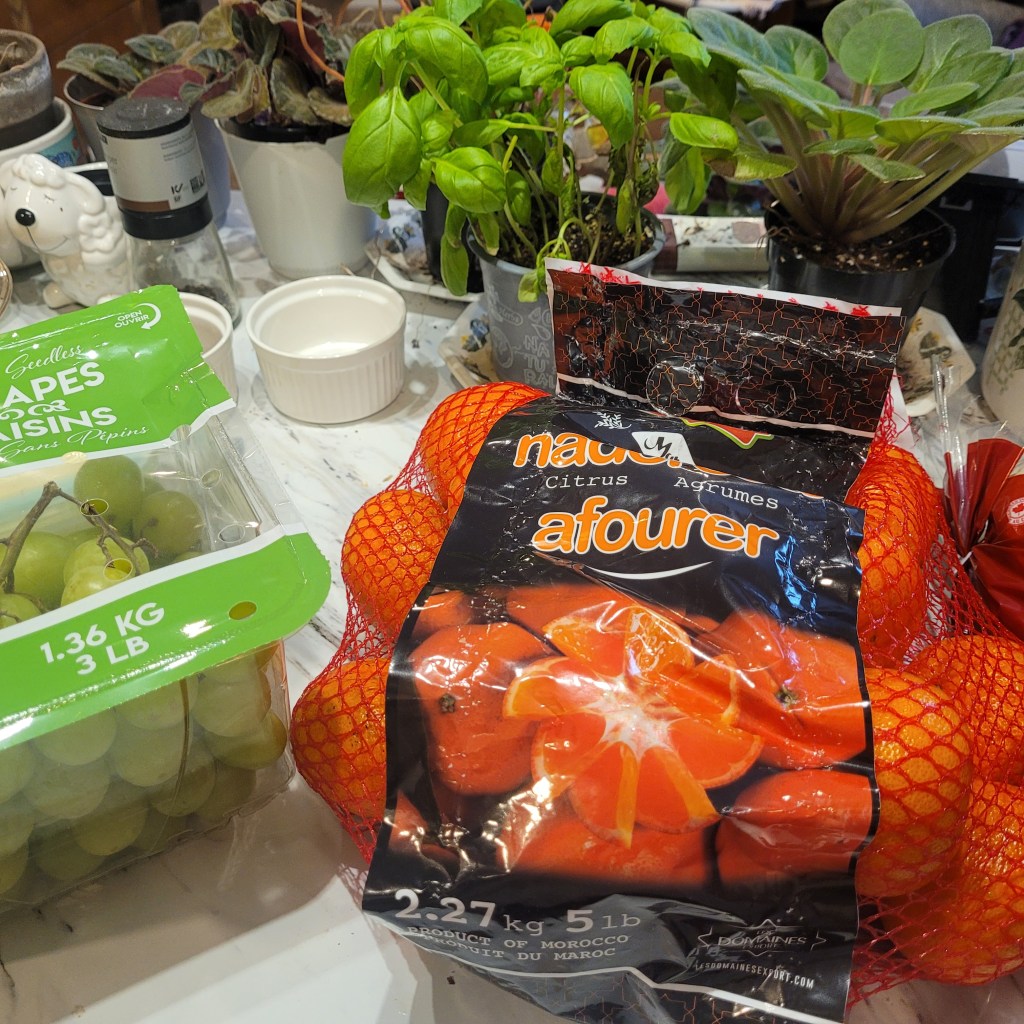
So, what’s working? I found a produce delivery company sourcing Canadian-grown vegetables, likely from the New Market area. The box was good, though I’d love to know exactly where each item comes from. I did sneak in four bananas from Costa Rica—I still want bananas in my life!
The big news? We joined Summit Dairy! It’s out past Dundas, and as of Thursday, we’ll get milk and cream delivered weekly. Their dairy is high quality, coming directly from their herd, and delivered in glass bottles with a deposit system. I’ll set the cooler out Wednesday night for the early morning delivery. I go through about a liter of cream a week, plus milk and their delicious chocolate milk as a treat.
Meat sourcing is a work in progress. I bought Canadian meat from Walmart but need to find out where exactly it’s sourced. I plan to visit Denninger’s for local meat and their incredible liverwurst. Other options include meat processors within the 100-mile radius.
Flour was another challenge. I bought no-name flour but couldn’t confirm the exact source. Moving forward, I’ll return to Arva Flour Mills. Their flour is fantastic, and I may order in bulk to make delivery worthwhile.
Garden Dreams and Final Thoughts
As I plan my tiny garden, I’m considering shade-friendly plants. Last year’s cucumbers did well, and I might try potatoes again with better trimming. Tomatoes are unlikely due to lack of sun, but radishes and peas can go in early, which is exciting! Friends have a garden and grew zucchini and beets for me last year—maybe I can work with them again this season.
So, that’s my check-in! The 100 Mile Life is on track, more or less. The key is remembering that I don’t need to order flour and coffee from big-box stores when I have local options. Every small choice makes a difference.
If you have any questions about the 100 Mile Life, knitting, spinning, or my dyed yarns, let me know! I’d love to hear from you. Whatever you do, I hope it brings you joy and allows you to bless others.
This is Doll from DollCanCreate. You can too! Until next time, friends—bye for now!